New Lightcast Report: AI Skills Command 28% Salary Premium as Demand Shifts Beyond Tech Industry — from lightcast.io; via Paul Fain
First-of-its-kind analysis reveals specific AI skills employers need most, enabling targeted workforce training strategies across all career areas

July 23, 2025 – Lightcast, the global leader in labor market intelligence, today released “Beyond the Buzz: Developing the AI Skills Employers Actually Need,” a comprehensive analysis revealing that artificial intelligence has fundamentally transformed hiring patterns across the world of work. The report, based on analysis of over 1.3 billion job postings, shows that job postings including AI skills offer 28% higher salaries—nearly $18,000 more per year—than those without such capabilities.

More importantly, the research analyzes specific skills based on their growth across job postings, their importance in the workforce, and their exposure to AI. This shows exactly which AI skills create value in which contexts, solving the critical challenge facing educators and workforce development leaders: moving beyond vague “AI literacy” to precise, targeted training that delivers measurable results.


Also via Paul Fain:


Despite growing awareness, however, participation in skill development is limited. In 2024, less than half of U.S. employees (45%) participated in training or education to build new skills for their current job. About one in three employees (32%) who are hoping to move into a new role within the next year strongly agree that they have the skills needed to be exceptional in that role.


From DSC:
In looking at
 
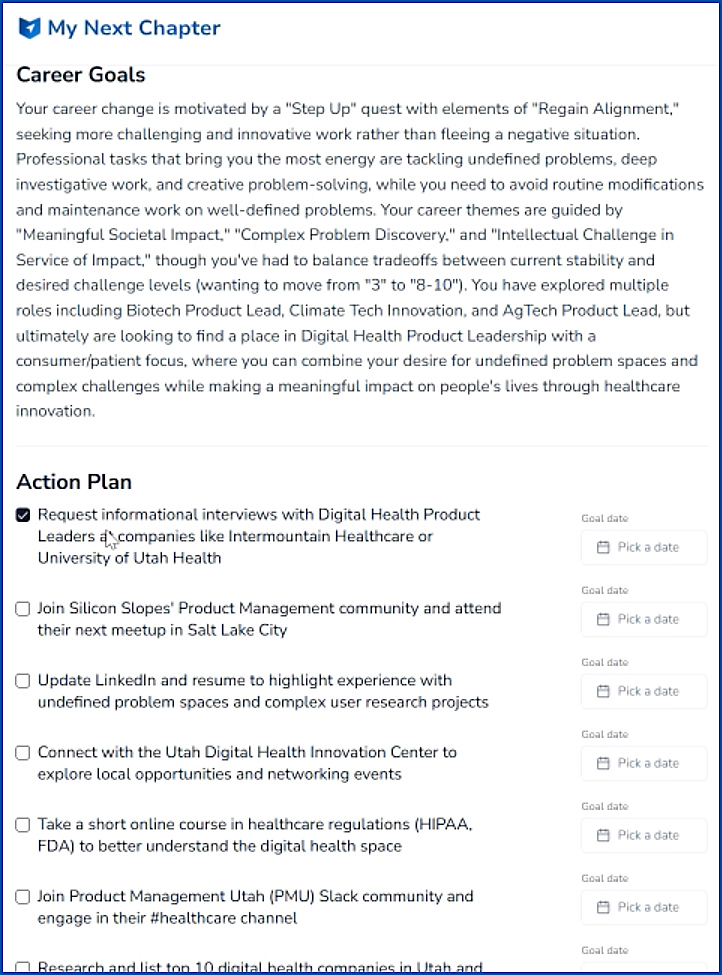
MyNextChapter.ai — THIS TYPE OF FUNCTIONALITY of an AI-based chatbot talking to you re: good fits for a future job — is the kind of thing that could work well in this type of vision/learning platform. The AI asks you relevant career-oriented questions, comes up with some potential job fits, and then gives you resources about how to gain those skills, who to talk with, organizations to join, next steps to get your foot in the door somewhere, etc.

The next gen learning platform would provide links to online-based courses, blogs, peoples’ names on LinkedIn, courses from L&D organizations or from institutions of higher education or from other entities/places to obtain those skills (similar to the ” Action Plan” below from MyNextChapter.ai).


Teach business students to write like executives — from timeshighereducation.com by José Ignacio Sordo Galarza
Many business students struggle to communicate with impact. Teach them to pitch ideas on a single page to build clarity, confidence and work-ready communication skills

Many undergraduate business students transition into the workforce equipped with communication habits that, while effective in academic settings, prove ineffective in professional environments. At university, students are trained to write for professors, not executives. This becomes problematic in the workplace where lengthy reports and academic jargon often obscure rather than clarify intent. Employers seek ideas they can absorb in seconds. This is where the one-pager – a single-page, high-impact document that helps students develop clarity of thought, concise expression and strategic communication – proves effective.


Also from Times Higher Education, see:


Is the dissertation dead? If so, what are the alternatives? — from timeshighereducation.com by Rushana Khusainova, Sarah Sholl, & Patrick Harte
Dissertation alternatives, such as capstone projects and applied group-based projects, could better prepare graduates for their future careers. Discover what these might look like

The traditional dissertation, a longstanding pillar of higher education, is facing increasing scrutiny. Concerns about its relevance to contemporary career paths, limitations in fostering practical skills and the changing nature of knowledge production in the GenAI age have fuelled discussions about its continued efficacy. So, is the dissertation dead?

The dissertation is facing a number of challenges. It can be perceived as having little relevance to career aspirations in increasingly competitive job markets. According to The Future of Jobs Report 2025 by the World Economic Forum, employers demand and indeed prioritise skills such as collaborative problem-solving in diverse and complex contexts, which a dissertation might not demonstrate.


Fresh Voices on Legal Tech with Mathew Kerbis — from legaltalknetwork.com by Mathew Kerbis, Dennis Kennedy, and Tom Mighell

New approaches to legal service delivery are propelling us into the future. Don’t get left behind! AI and automations are making alternative service delivery easier and more efficient than ever. Dennis & Tom welcome Mathew Kerbis to learn more about his expertise in subscription-based legal services.


The Business Case For Legal Tech — from lexology.com

What a strong business case includes
A credible business case has three core elements: a clear problem statement, a defined solution, and a robust analysis of expected impact. It should also demonstrate that legal has done its homework and thought beyond implementation.

  1. Problem definition
  2. Current state analysis
  3. Solution overview
  4. Impact assessment
  5. Implementation plan
  6. Cost summary and ROI
  7. Strategic alignment

How AI is Revolutionizing Legal Technology in 2025 — from itmunch.com by Gaurav Uttamchandani

Table of Contents

  • What is AI in Legal Technology?
  • Key Use Cases of AI in the Legal Industry
    • 1. Contract Review & Management
    • 2. Legal Research & Case Analysis
    • 3. Litigation Prediction & Risk Assessment
    • 4. E-Discovery
    • 5. Legal Chatbots & Virtual Assistants
  • Benefits of AI in Legal Tech
  • Real-World Example: AI in Action
  • Implementing AI in Your Law Firm: Step-by-Step
  • Addressing Concerns Around AI in Law
  • LegalTech Trends to Watch in 2025
  • Final Thoughts
  • Call-to-Action (CTA)


From DSC:
This one is for the youth out there. Learn these lessons NOW, before you go too much further in your journey here on Earth. If you do, you will reap the benefits of this learning for the rest of your days.

As I mentioned to our own kids when I forwarded this article to them:


My dad passed along a bit of wisdom to me when he told me what *his* dad (my Grandpa Christian) had told him:
“If a job is worth doing, it’s worth doing well.” 
I’ve always remembered that and I *try* to do quality work.
The following article is worth your time. It touches upon a similar idea:
.
You’re Always Building Your Own House— from sahilbloom.com by Sahil Bloom; with thanks to Roberto Ferraro for this resource
.
I pass it along to help us *try* to do quality things and work…but NOT to load up unrealistic expectations on ourselves or create a harried, perfectionistic lifestyle. 

Excerpt:

An old carpenter told his boss that he planned to retire. The boss was sad to lose the carpenter, but understood.

He asked if he’d stick around for one last job—to build one final house.

The carpenter reluctantly agreed, figuring he could get it done quickly. He cut corners, used cheap materials, and rushed through the work.

When the house was done, his boss arrived for the final inspection. But instead of walking the house, he reached into his pocket, and handed the carpenter the keys.

“This is your house,” his boss smiled, “My retirement gift to you.”

The carpenter was stunned. If he’d known he was building his own house, he would have done it differently. Now he’d have to live in a house he had built none too well.

The lesson: You’re always building your own house.


Is graduate employability a core university priority? — from timeshighereducation.com by Katherine Emms and Andrea Laczik
Universities, once judged primarily on the quality of their academic outcomes, are now also expected to prepare students for the workplace. Here’s how higher education is adapting to changing pressures

A clear, deliberate shift in priorities is under way. Embedding employability is central to an Edge Foundation report, carried out in collaboration with UCL’s Institute of Education, looking at how English universities are responding. In placing employability at the centre of their strategies – not just for professional courses but across all disciplines – the two universities that were analysed in this research show how they aim to prepare students for the labour market overall. Although the employability strategy is initialled by the universities’ senior leaders, the research showed that realising this employability strategy must be understood and executed by staff at all levels across departments. The complexity of offering insights into industry pathways and building relevant skills involves curricula development, student-centred teaching, careers support, partnership work and employer engagement.


Every student can benefit from an entrepreneurial mindset — from timeshighereducation.com by Nicolas Klotz
To develop the next generation of entrepreneurs, universities need to nurture the right mindset in students of all disciplines. Follow these tips to embed entrepreneurial education

This shift demands a radical rethink of how we approach entrepreneurial mindset in higher education. Not as a specialism for a niche group of business students but as a core competency that every student, in every discipline, can benefit from.

At my university, we’ve spent the past several years re-engineering how we embed entrepreneurship into daily student life and learning.

What we’ve learned could help other institutions, especially smaller or resource-constrained ones, adapt to this new landscape.

The first step is recognising that entrepreneurship is not only about launching start-ups for profit. It’s about nurturing a mindset that values initiative, problem-solving, resilience and creative risk-taking. Employers increasingly want these traits, whether the student is applying for a traditional job or proposing their own venture.


Build foundations for university-industry partnerships in 90 days— from timeshighereducation.com by Raul Villamarin Rodriguez and Hemachandran K
Graduate employability could be transformed through systematic integration of industry partnerships. This practical guide offers a framework for change in Indian universities

The most effective transformation strategy for Indian universities lies in systematic industry integration that moves beyond superficial partnerships and towards deep curriculum collaboration. Rather than hoping market alignment will occur naturally, institutions must reverse-engineer academic programmes from verified industry needs.

Our six-month implementation at Woxsen University demonstrates this framework’s practical effectiveness, achieving more than 130 industry partnerships, 100 per cent faculty participation in transformation training, and 75 per cent of students receiving industry-validated credentials with significantly improved employment outcomes.


In A Mega Deal, Clio Buys vLex for $1 Billion, Merging AI, Research and Practice Management — from lawnext.com by Bob Ambrogi

In a landmark deal that will undoubtedly reshape the legal tech landscape, law practice management company Clio has signed a definitive agreement to acquire the AI and legal research company vLex for $1 billion in cash and stock.

The companies say that the acquisition will “establish a new category of intelligent legal technology at the intersection of the business and practice of law, empowering legal professionals to seamlessly manage, research, and execute legal work within a unified system.”


What enterprise leaders can learn from LinkedIn’s success with AI agents — from venturebeat.com by Taryn Plumb

LinkedIn is taking a multi-agent approach, using what Agarwal described as a collection of agents collaborating to get the job done. A supervisor agent orchestrates all the tasks among other agents, including intake and sourcing agents that are “good at one and only one job.”

All communication occurs through the supervisor agent, which receives input from human users regarding role qualifications and other details. That agent then provides context to a sourcing agent, which culls through recruiter search stacks and sources candidates along with descriptions on why they might be a good fit for the job. That information is then returned to the supervisor agent, which begins actively interacting with the human user.

“Then you can collaborate with it, right?” said Agarwal. “You can modify it. No longer do you have to talk to the platform in keywords. You can talk to the platform in natural language, and it’s going to answer you back, it’s going to have a conversation with you.”


2025 Learning System Top Picks — from elearninfo247.com by Craig Weiss

Who is leading the pack? Who is setting themselves apart here in the mid-year?

Are they an LMS? LMS/LXP? Talent Development System? Mentoring? Learning Platform?

Something else?

Are they solely customer training/education, mentoring, or coaching? Are they focused only on employees? Are they an amalgamation of all or some?

Well, they cut across the board – hence, they slide under the “Learning Systems” umbrella, which is under the bigger umbrella term – “Learning Technology.”

Categories: L&D-specific, Combo (L&D and Training, think internal/external audiences), and Customer Training/Education (this means customer education, which some vendors use to mean the same as customer training).


Agentic AI use cases in the legal industry — from legal.thomsonreuters.com
What legal professionals need to know now with the rise of agentic AI

While GenAI can create documents or answer questions, agentic AI takes intelligence a step further by planning how to get multi-step work done, including tasks such as consuming information, applying logic, crafting arguments, and then completing them.? This leaves legal teams more time for nuanced decision-making, creative strategy, and relationship-building with clients—work that machines can’t do.


The AI Legal Landscape in 2025: Beyond the Hype — from akerman.com by Melissa C. Koch

What we’re witnessing is a profession in transition where specific tasks are being augmented or automated while new skills and roles emerge.

The data tells an interesting story: approximately 79% of law firms have integrated AI tools into their workflows, yet only a fraction have truly transformed their operations. Most implementations focus on pattern recognition tasks such as document review, legal research, contract analysis. These implementations aren’t replacing lawyers; they’re redirecting attention to higher-value work.

This technological shift doesn’t happen in isolation. It’s occurring amid client pressure for efficiency, competition from alternative providers, and the expectations of a new generation of lawyers who have never known a world without AI assistance.


LexisNexis and Harvey team up to revolutionize legal research with artificial intelligence — from abajournal.com by Danielle Braff

Lawyers using the Harvey artificial intelligence platform will soon be able to tap into LexisNexis’ vast legal research capabilities.

Thanks to a new partnership announced Wednesday, Harvey users will be able to ask legal questions and receive fast, citation-backed answers powered by LexisNexis case law, statutes and Shepard’s Citations, streamlining everything from basic research to complex motions. According to a press release, generated responses to user queries will be grounded in LexisNexis’ proprietary knowledge graphs and citation tools—making them more trustworthy for use in court or client work.


10 Legal Tech Companies to Know — from builtin.com
These companies are using AI, automation and analytics to transform how legal work gets done.
.


Four months after a $3B valuation, Harvey AI grows to $5B — from techcrunch.com by Marina Temkin

Harvey AI, a startup that provides automation for legal work, has raised $300 million in Series E funding at a $5 billion valuation, the company told Fortune. The round was co-led by Kleiner Perkins and Coatue, with participation from existing investors, including Conviction, Elad Gil, OpenAI Startup Fund, and Sequoia.


The billable time revolution — from jordanfurlong.substack.com by Jordan Furlong
Gen AI will bring an end to the era when lawyers’ value hinged on performing billable work. Grab the coming opportunity to re-prioritize your daily activities and redefine your professional purpose.

Because of Generative AI, lawyers will perform fewer “billable” tasks in future; but why is that a bad thing? Why not devote that incoming “freed-up” time to operating, upgrading, and flourishing your law practice? Because this is what you do now: You run a legal business. You deliver good outcomes, good experiences, and good relationships to clients. Humans do some of the work and machines do some of the work and the distinction that matters is not billable/non-billable, it’s which type of work is best suited to which type of performer.


How Do You Build a Learner-Centered Ecosystem? — from gettingsmart.com by Bobbi Macdonald and Alin Bennett

Key Points

  • It’s not just about redesigning public education—it’s about rethinking how, where and with whom learning happens. Communities across the United States are shaping learner-centered ecosystems and gathering insights along the way.
  • What does it take to build a learner-centered ecosystem? A shared vision. Distributed leadership. Place-based experiences.  Repurposed resources. And more. This piece unpacks 10 real-world insights from pilots in action.
    .

We believe the path forward is through the cultivation of learner-centered ecosystems — adaptive, networked structures that offer a transformed way of organizing, supporting, and credentialing community-wide learning. These ecosystems break down barriers between schools, communities, and industries, creating flexible, real-world learning experiences that tap into the full range of opportunities a community has to offer.

Last year, we announced our Learner-Centered Ecosystem Lab, a collaborative effort to create a community of practice consisting of twelve diverse sites across the country — from the streets of Brooklyn to the mountains of Ojai — that are demonstrating or piloting ecosystemic approaches. Since then, we’ve been gathering together, learning from one another, and facing the challenges and opportunities of trying to transform public education. And while there is still much more work to be done, we’ve begun to observe a deeper pattern language — one that aligns with our ten-point Ecosystem Readiness Framework, and one that, we hope, can help all communities start to think more practically and creatively about how to transform their own systems of learning.

So while it’s still early, we suspect that the way to establish a healthy learner-centered ecosystem is by paying close attention to the following ten conditions:


“The AI-enhanced learning ecosystem” [Jennings] + other items re: AI in our learning ecosystems

The AI-enhanced learning ecosystem: A case study in collaborative innovation — from chieflearningofficer.com by Kevin Jennings
How artificial intelligence can serve as a tool and collaborative partner in reimagining content development and management.

Learning and development professionals face unprecedented challenges in today’s rapidly evolving business landscape. According to LinkedIn’s 2025 Workplace Learning Report, 67 percent of L&D professionals report being “maxed out” on capacity, while 66 percent have experienced budget reductions in the past year.

Despite these constraints, 87 percent agree their organizations need to develop employees faster to keep pace with business demands. These statistics paint a clear picture of the pressure L&D teams face: do more, with less, faster.

This article explores how one L&D leader’s strategic partnership with artificial intelligence transformed these persistent challenges into opportunities, creating a responsive learning ecosystem that addresses the modern demands of rapid product evolution and diverse audience needs. With 71 percent of L&D professionals now identifying AI as a high or very high priority for their learning strategy, this case study demonstrates how AI can serve not merely as a tool but as a collaborative partner in reimagining content development and management.
.


How we use GenAI and AR to improve students’ design skills — from timeshighereducation.com by Antonio Juarez, Lesly Pliego and Jordi Rábago who are professors of architecture at Monterrey Institute of Technology in Mexico; Tomas Pachajoa is a professor of architecture at the El Bosque University in Colombia; & Carlos Hinrichsen and Marietta Castro are educators at San Sebastián University in Chile.
Guidance on using generative AI and augmented reality to enhance student creativity, spatial awareness and interdisciplinary collaboration

Blend traditional skills development with AI use
For subjects that require students to develop drawing and modelling skills, have students create initial design sketches or models manually to ensure they practise these skills. Then, introduce GenAI tools such as Midjourney, Leonardo AI and ChatGPT to help students explore new ideas based on their original concepts. Using AI at this stage broadens their creative horizons and introduces innovative perspectives, which are crucial in a rapidly evolving creative industry.

Provide step-by-step tutorials, including both written guides and video demonstrations, to illustrate how initial sketches can be effectively translated into AI-generated concepts. Offer example prompts to demonstrate diverse design possibilities and help students build confidence using GenAI.

Integrating generative AI and AR consistently enhanced student engagement, creativity and spatial understanding on our course. 


How Texas is Preparing Higher Education for AI — from the74million.org by Kate McGee
TX colleges are thinking about how to prepare students for a changing workforce and an already overburdened faculty for new challenges in classrooms.

“It doesn’t matter if you enter the health industry, banking, oil and gas, or national security enterprises like we have here in San Antonio,” Eighmy told The Texas Tribune. “Everybody’s asking for competency around AI.”

It’s one of the reasons the public university, which serves 34,000 students, announced earlier this year that it is creating a new college dedicated to AI, cyber security, computing and data science. The new college, which is still in the planning phase, would be one of the first of its kind in the country. UTSA wants to launch the new college by fall 2025.

But many state higher education leaders are thinking beyond that. As AI becomes a part of everyday life in new, unpredictable ways, universities across Texas and the country are also starting to consider how to ensure faculty are keeping up with the new technology and students are ready to use it when they enter the workforce.


In the Room Where It Happens: Generative AI Policy Creation in Higher Education — from er.educause.edu by Esther Brandon, Lance Eaton, Dana Gavin, and Allison Papini

To develop a robust policy for generative artificial intelligence use in higher education, institutional leaders must first create “a room” where diverse perspectives are welcome and included in the process.


Q&A: Artificial Intelligence in Education and What Lies Ahead — from usnews.com by Sarah Wood
Research indicates that AI is becoming an essential skill to learn for students to succeed in the workplace.

Q: How do you expect to see AI embraced more in the future in college and the workplace?
I do believe it’s going to become a permanent fixture for multiple reasons. I think the national security imperative associated with AI as a result of competing against other nations is going to drive a lot of energy and support for AI education. We also see shifts across every field and discipline regarding the usage of AI beyond college. We see this in a broad array of fields, including health care and the field of law. I think it’s here to stay and I think that means we’re going to see AI literacy being taught at most colleges and universities, and more faculty leveraging AI to help improve the quality of their instruction. I feel like we’re just at the beginning of a transition. In fact, I often describe our current moment as the ‘Ask Jeeves’ phase of the growth of AI. There’s a lot of change still ahead of us. AI, for better or worse, it’s here to stay.


AI-Generated Podcasts Outperform Textbooks in Landmark Education Study — form linkedin.com by David Borish

A new study from Drexel University and Google has demonstrated that AI-generated educational podcasts can significantly enhance both student engagement and learning outcomes compared to traditional textbooks. The research, involving 180 college students across the United States, represents one of the first systematic investigations into how artificial intelligence can transform educational content delivery in real-time.


What can we do about generative AI in our teaching?  — from linkedin.com by Kristina Peterson

So what can we do?

  • Interrogate the Process: We can ask ourselves if we I built in enough checkpoints. Steps that can’t be faked. Things like quick writes, question floods, in-person feedback, revision logs.
  • Reframe AI: We can let students use AI as a partner. We can show them how to prompt better, revise harder, and build from it rather than submit it. Show them the difference between using a tool and being used by one.
  • Design Assignments for Curiosity, Not Compliance: Even the best of our assignments need to adapt. Mine needs more checkpoints, more reflective questions along the way, more explanation of why my students made the choices they did.

Teachers Are Not OK — from 404media.co by Jason Koebler

The response from teachers and university professors was overwhelming. In my entire career, I’ve rarely gotten so many email responses to a single article, and I have never gotten so many thoughtful and comprehensive responses.

One thing is clear: teachers are not OK.

In addition, universities are contracting with companies like Microsoft, Adobe, and Google for digital services, and those companies are constantly pushing their AI tools. So a student might hear “don’t use generative AI” from a prof but then log on to the university’s Microsoft suite, which then suggests using Copilot to sum up readings or help draft writing. It’s inconsistent and confusing.

I am sick to my stomach as I write this because I’ve spent 20 years developing a pedagogy that’s about wrestling with big ideas through writing and discussion, and that whole project has been evaporated by for-profit corporations who built their systems on stolen work. It’s demoralizing.


Astronaut one day, artist the next: How to help children explore the world of careers — from apnews.com by Cathy Bussewitz

Sometimes career paths follow a straight line, with early life ambitions setting us on a clear path to training or a degree and a specific profession. Just as often, circumstance, luck, exposure and a willingness to adapt to change influence what we do for a living.

Developmental psychologists and career counselors recommend exposing children to a wide variety of career paths at a young age.

“It’s not so that they’ll pick a career, but that they will realize that there’s lots of opportunities and not limit themselves out of careers,” said Jennifer Curry, a Louisiana State University professor who researches career and college readiness.

Preparing for a world of AI
In addition to exposing children to career routes through early conversations and school courses, experts recommend teaching children about artificial intelligence and how it is reshaping the world and work.


The 2025 Global Skills Report— from coursera.org
Discover in-demand skills and credentials trends across 100+ countries and six regions to deliver impactful industry-aligned learning programs.

GenAI adoption fuels global skill demands
In 2023, early adopters flocked to GenAI, with approximately one person per minute enrolling in a GenAI course on Coursera —a rate that rose to eight per minute in 2024.  Since then, GenAI has continued to see exceptional growth, with global enrollment in GenAI courses surging 195% year-over-year—maintaining its position as one of the most rapidly growing skill domains on our platform. To date, Coursera has recorded over 8 million GenAI enrollments, with 12 learners per minute signing up for GenAI content in 2025 across our catalog of nearly 700 GenAI courses.

Driving this surge, 94% of employers say they’re likely to hire candidates with GenAI credentials, while 75% prefer hiring less-experienced candidates with GenAI skills over more experienced ones without these capabilities.8 Demand for roles such as AI and Machine Learning Specialists is projected to grow by up to 40% in the next four years.9 Mastering AI fundamentals—from prompt engineering to large language model (LLM) applications—is essential to remaining competitive in today’s rapidly evolving economy.

Countries leading our new AI Maturity Index— which highlights regions best equipped to harness AI innovation and translate skills into real-world applications—include global frontrunners such as Singapore, Switzerland, and the United States.

Insights in action

Businesses
Integrate role-specific GenAI modules into employee development programs, enabling teams to leverage AI for efficiency and innovation.

Governments
Scale GenAI literacy initiatives—especially in emerging economies—to address talent shortages and foster human-machine capabilities needed to future-proof digital jobs.

Higher education
Embed credit-eligible GenAI learning into curricula, ensuring graduates enter the workforce job-ready.

Learners
Focus on GenAI courses offering real-world projects (e.g., prompt engineering) that help build skills for in-demand roles.

 
© 2025 | Daniel Christian