AI Has Landed in Education: Now What? — from learningfuturesdigest.substack.com by Dr. Philippa Hardman
Here’s what’s shaped the AI-education landscape in the last month:
- The AI Speed Trap is [still] here: AI adoption in L&D is basically won (87%)—but it’s being used to ship faster, not learn better (84% prioritising speed), scaling “more of the same” at pace.
- AI tutors risk a “pedagogy of passivity”: emerging evidence suggests tutoring bots can reduce cognitive friction and pull learners down the ICAP spectrum—away from interactive/constructive learning toward efficient consumption.
- Singapore + India are building what the West lacks: they’re treating AI as national learning infrastructure—for resilience (Singapore) and access + language inclusion (India)—while Western systems remain fragmented and reactive.
- Agentic AI is the next pivot: early signs show a shift from AI as a content engine to AI as a learning partner—with UConn using agents to remove barriers so learners can participate more fully in shared learning.
- Moodle’s AI stance sends two big signals: the traditional learning ecosystem in fragmenting, and the concept of “user sovereignty” over by AI is emerging.
Four strategies for implementing custom AIs that help students learn, not outsource — from educational-innovation.sydney.edu.au by Kria Coleman, Matthew Clemson, Laura Crocco and Samantha Clarke; via Derek Bruff
For Cogniti to be taken seriously, it needs to be woven into the structure of your unit and its delivery, both in class and on Canvas, rather than left on the side. This article shares practical strategies for implementing Cogniti in your teaching so that students:
- understand the context and purpose of the agent,
- know how to interact with it effectively,
- perceive its value as a learning tool over any other available AI chatbots, and
- engage in reflection and feedback.
In this post, we discuss how to introduce and integrate Cogniti agents into the learning environment so students understand their context, interact effectively, and see their value as customised learning companions.
In this post, we share four strategies to help introduce and integrate Cogniti in your teaching so that students understand their context, interact effectively, and see their value as customised learning companions.
Collection: Teaching with Custom AI Chatbots — from teaching.virginia.edu; via Derek Bruff
The default behaviors of popular AI chatbots don’t always align with our teaching goals. This collection explores approaches to designing AI chatbots for particular pedagogical purposes.
Example/excerpt:
- Not Your Default Chatbot: Five Teaching Applications of Custom AI Bots
Agile Learning
derekbruff.org/2025/10/01/five-teaching-applications-of-custom-ai-chatbots/
7 Legal Tech Trends That Will Reshape Every Business In 2026 — from forbes.com by Bernard Marr
Here are the trends that will matter most.
- AI Agents As Legal Assistants
- AI As A Driver Of Business Strategy
- Automation In Judicial Administration
- Always-On Compliance Monitoring
- Cybersecurity As An Essential Survival Tool
- Predictive Litigation
- Compliance As Part Of The Everyday Automation Fabric
According to the Thomson Reuters Future Of Professionals report, most experts already expect AI to transform their work within five years, with many viewing it as a positive force. The challenge now is clear: legal and compliance leaders must understand the tools reshaping their field and prepare their teams for a very different way of working in 2026.
Addendum on 12/17/25:
- Top 10 legal tech episodes in 2025 — from lawyersweekly.com.au
With AI and legal technology at the forefront of the profession’s mind now more than ever, The Lawyers Weekly Show and our special series LawTech Talks delivered in-depth explorations of these game-changing topics. Now, we’re highlighting the 10 most downloaded episodes that sparked conversation across the legal tech community. - eCourtDate Winner Of “LegalOps Platform of the Year” In 2025 LegalTech Breakthrough Awards Program — from globenewswire.com
Prestigious Annual Awards Program Recognizes Companies and Products Driving Innovation in the Global Legal Industry
2. Concern and excitement about AI — from pewresearch.org by Jacob Poushter,Moira Faganand Manolo Corichi
Key findings
- A median of 34% of adults across 25 countries are more concerned than excited about the increased use of artificial intelligence in daily life. A median of 42% are equally concerned and excited, and 16% are more excited than concerned.
- Older adults, women, people with less education and those who use the internet less often are particularly likely to be more concerned than excited.
Also relevant here:
- The U.S. Public Wants Regulation (or Prohibition) of Expert-Level and Superhuman AI — from futureoflife.org
Three?quarters of U.S. adults want strong regulations on AI development, preferring oversight akin to pharmaceuticals rather than industry “self?regulation.”
AI Video Wars include Veo 3.1, Sora 2, Ray3, Kling 2.5 + Wan 2.5 — from heatherbcooper.substack.com by Heather Cooper
House of David Season 2 is here!
In today’s edition:
- Veo 3.1 brings richer audio and object-level editing to Google Flow
- Sora 2 is here with Cameo self-insertion and collaborative Remix features
- Ray3 brings world-first reasoning and HDR to video generation
- Kling 2.5 Turbo delivers faster, cheaper, more consistent results
- WAN 2.5 revolutionizes talking head creation with perfect audio sync
- House of David Season 2 Trailer
- HeyGen Agent, Hailuo Agent, Topaz Astra, and Lovable Cloud updates
- Image & Video Prompts
From DSC:
By the way, the House of David (which Heather referred to) is very well done! I enjoyed watching Season 1. Like The Chosen, it brings the Bible to life in excellent, impactful ways! Both series convey the context and cultural tensions at the time. Both series are an answer to prayer for me and many others — as they are professionally-done. Both series match anything that comes out of Hollywood in terms of the acting, script writing, music, the sets, etc. Both are very well done.
.
An item re: Sora:
- Association of Talent Agents, United Talent Agency, Creative Artists Agency also Join to Protect Performers. — from sagaftra.org
Other items re: Open AI’s new Atlas browser:
Introducing ChatGPT Atlas — from openai.com
The browser with ChatGPT built in.
[On 10/21/25] we’re introducing ChatGPT Atlas, a new web browser built with ChatGPT at its core.
AI gives us a rare moment to rethink what it means to use the web. Last year, we added search in ChatGPT so you could instantly find timely information from across the internet—and it quickly became one of our most-used features. But your browser is where all of your work, tools, and context come together. A browser built with ChatGPT takes us closer to a true super-assistant that understands your world and helps you achieve your goals.
With Atlas, ChatGPT can come with you anywhere across the web—helping you in the window right where you are, understanding what you’re trying to do, and completing tasks for you, all without copying and pasting or leaving the page. Your ChatGPT memory is built in, so conversations can draw on past chats and details to help you get new things done.
ChatGPT Atlas: the AI browser test — from getsuperintel.com by Kim “Chubby” Isenberg
Chat GPT Atlas aims to transform web browsing into a conversational, AI-native experience, but early reviews are mixed
OpenAI’s new ChatGPT Atlas promises to merge web browsing, search, and automation into a single interface — an “AI-native browser” meant to make the web conversational. After testing it myself, though, I’m still trying to see the real breakthrough. It feels familiar: summaries, follow-ups, and even the Agent’s task handling all mirror what I already do inside ChatGPT.
OpenAI’s new Atlas browser remembers everything — from theneurondaily.com by Grant Harvey
PLUS: Our AIs are getting brain rot?!
Here’s how it works: Atlas can see what you’re looking at on any webpage and instantly help without you needing to copy/paste or switch tabs. Researching hotels? Ask ChatGPT to compare prices right there. Reading a dense article? Get a summary on the spot. The AI lives in the browser itself.
OpenAI’s new product — from bensbites.com
The latest entry in AI browsers is Atlas – A new browser from OpenAI. Atlas would feel similar to Dia or Comet if you’ve used them. It has an “Ask ChatGPT” sidebar that has the context of your page, and choose “Agent” to work on that tab. Right now, Agent is limited to a single tab, and it is way too slow to delegate anything for real to it. Click accuracy for Agent is alright on normal web pages, but it will definitely trip up if you ask it to use something like Google Sheets.
One ambient feature that I think many people will like is “select to rewrite” – You can select any text in Atlas, hover/click on the blue dot in the top right corner to rewrite it using AI.
Your AI Resume Hacks Probably Won’t Fool Hiring Algorithms — from builtin.com by Jeff Rumage
Recruiters say those viral hidden prompt for resumes don’t work — and might cost you interviews.
Summary: Job seekers are using “prompt hacking” — embedding hidden AI commands in white font on resumes — to try to trick applicant tracking systems. While some report success, recruiters warn the tactic could backfire and eliminate the candidate from consideration.
The Job Market Might Be a Mess, But Don’t Blame AI Just Yet — from builtin.com by Matthew Urwin
A new study by Yale University and the Brookings Institution says the panic around artificial intelligence stealing jobs is overblown. But that might not be the case for long.
Summary: A Yale and Brookings study finds generative AI has had little impact on U.S. jobs so far, with tariffs, immigration policies and the number of college grads potentially playing a larger role. Still, AI could disrupt the workforce in the not-so-distant future.
International AI Safety Report — from internationalaisafetyreport.org
About the International AI Safety Report
The International AI Safety Report is the world’s first comprehensive review of the latest science on the capabilities and risks of general-purpose AI systems. Written by over 100 independent experts and led by Turing Award winner Yoshua Bengio, it represents the largest international collaboration on AI safety research to date. The Report gives decision-makers a shared global picture of AI’s risks and impacts, serving as the authoritative reference for governments and organisations developing AI policies worldwide. It is already shaping debates and informing evidence-based decisions across research and policy communities.
3 Work Trends – Issue 87 — from the World Economic Forum
1. #AI adoption is delivering real results for early movers
Three years into the generative AI revolution, a small but growing group of global companies is demonstrating the tangible potential of AI. Among firms with revenues of $1 billion or more:
- 17% report cost savings or revenue growth of at least 10% from AI.
- Almost 80% say their AI investments have met or exceeded expectations.
- Half worry they are not moving fast enough and could fall behind competitors.
The world’s first AI cabinet member — from therundown.ai by Zach Mink, Rowan Cheung, Shubham Sharma, Joey Liu & Jennifer Mossalgue
PLUS: Startup produces 3,000 AI podcast episodes weekly
The details:
- Prime Minister Edi Rama unveiled Diella during a cabinet announcement this week, calling her the first member “virtually created by artificial intelligence”.
- The AI avatar will evaluate and award all public tenders where the government contracts private firms.
- Diella already serves citizens through Albania’s digital services portal, processing bureaucratic requests via voice commands.
- Rama claims the AI will eliminate bribes and threats from decision-making, though the government hasn’t detailed what human oversight will exist.
The Rundown AI’s article links to:
- Albania appoints world’s first AI-made minister — from politico.eu by Alice Taylor
Diella, who is powered by artificial intelligence, will handle public procurement.
Anthropic Economic Index report: Uneven geographic and enterprise AI adoption — from anthropic.com
In other words, a hallmark of early technological adoption is that it is concentrated—in both a small number of geographic regions and a small number of tasks in firms. As we document in this report, AI adoption appears to be following a similar pattern in the 21st century, albeit on shorter timelines and with greater intensity than the diffusion of technologies in the 20th century.
To study such patterns of early AI adoption, we extend the Anthropic Economic Index along two important dimensions, introducing a geographic analysis of Claude.ai conversations and a first-of-its-kind examination of enterprise API use. We show how Claude usage has evolved over time, how adoption patterns differ across regions, and—for the first time—how firms are deploying frontier AI to solve business problems.
How human-centric AI can shape the future of work — from weforum.org by Sapthagiri Chapalapalli
- Last year, use of AI in the workplace increased by 5.5% in Europe alone.
- AI adoption is accelerating, but success depends on empowering people, not just deploying technology.
- Redesigning roles and workflows to combine human creativity and critical thinking with AI-driven insights is key.
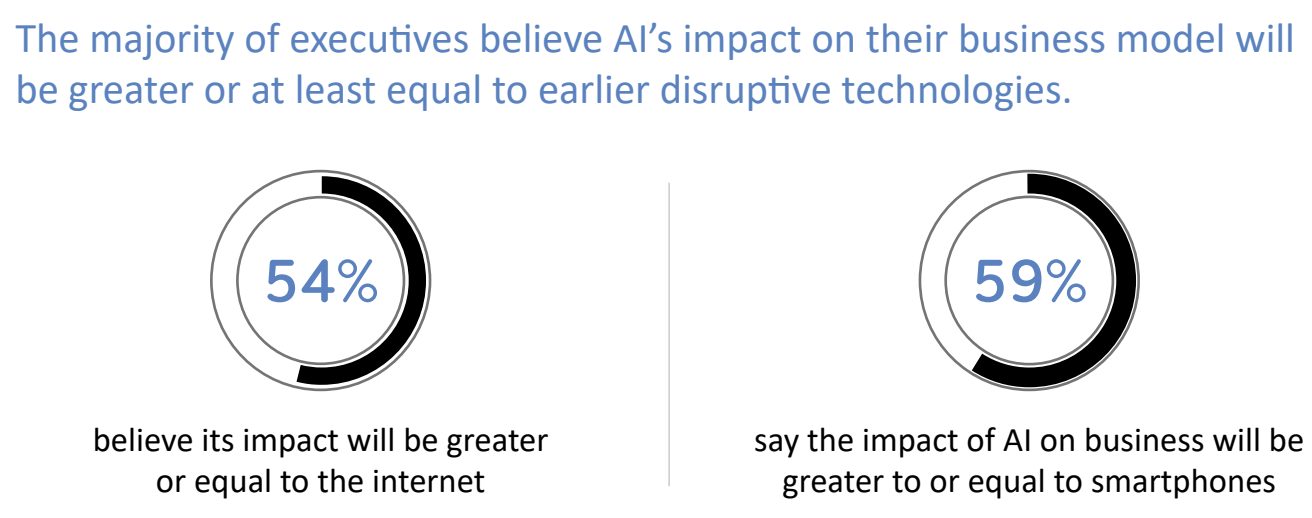
Organizations are having to rapidly adapt their business models. Image: TCS
Using ChatGPT to get a job — from linkedin.com by Ishika Rawat
Artificial Intelligence in Vocational Education — from leonfurze.com by Leon Furze
The vocational education sector is incredibly diverse, covering everything from trades like building and construction, electrical, plumbing and automotive through to allied health, childcare, education, the creative arts and the technology industry. In Canberra, we heard from people representing every corner of the industry, including education, retail, tourism, finance and digital technologies. Every one of these industries is being impacted by the current AI boom.
…
A theme of the day was that whilst the vocational education sector is seen as a slow-moving beast with its own peculiar red tape, it is still possible to respond to emerging technologies like artificial intelligence, and there’s an imperative to do so.
Coming back to GenAI for small business owners, a qualified plumber running their own business, either as a solo operator or as manager of a team, probably doesn’t have many opportunities to keep up to date with the rapid developments of digital technologies. They’re far too busy doing their job.
So vocational education and training can be an initial space to develop some skills and understanding of the technology in a way which can be beneficial for managing that day-to-day job.
And speaking of the trade schools/vocational world…
Social media opens a window to traditional trades for young workers — from washingtonpost.com by Taylor Telford; this is a gifted article
Worker influencers are showing what life is like in fields such as construction, plumbing and manufacturing. Trade schools are trying to make the most of it.
Social media is increasingly becoming a destination for a new generation to learn about skilled trades — at a time when many have grown skeptical about the cost of college and the promise of white-collar jobs. These posts offer authentic insight as workers talk openly about everything from their favorite workwear to safety and payday routines.
The exposure is also changing the game for trade schools and employers in such industries as manufacturing and construction, which have long struggled to attract workers. Now, some are evolving their recruiting tactics by wading into content creation after decades of relying largely on word of mouth.
Fresh Voices on Legal Tech with Mathew Kerbis — from legaltalknetwork.com by Mathew Kerbis, Dennis Kennedy, and Tom Mighell
New approaches to legal service delivery are propelling us into the future. Don’t get left behind! AI and automations are making alternative service delivery easier and more efficient than ever. Dennis & Tom welcome Mathew Kerbis to learn more about his expertise in subscription-based legal services.
The Business Case For Legal Tech — from lexology.com
What a strong business case includes
A credible business case has three core elements: a clear problem statement, a defined solution, and a robust analysis of expected impact. It should also demonstrate that legal has done its homework and thought beyond implementation.
- Problem definition
- Current state analysis
- Solution overview
- Impact assessment
- Implementation plan
- Cost summary and ROI
- Strategic alignment
How AI is Revolutionizing Legal Technology in 2025 — from itmunch.com by Gaurav Uttamchandani
Table of Contents
- What is AI in Legal Technology?
- Key Use Cases of AI in the Legal Industry
- 1. Contract Review & Management
- 2. Legal Research & Case Analysis
- 3. Litigation Prediction & Risk Assessment
- 4. E-Discovery
- 5. Legal Chatbots & Virtual Assistants
- Benefits of AI in Legal Tech
- Real-World Example: AI in Action
- Implementing AI in Your Law Firm: Step-by-Step
- Addressing Concerns Around AI in Law
- LegalTech Trends to Watch in 2025
- Final Thoughts
- Call-to-Action (CTA)
Multiple Countries Just Issued Travel Warnings for the U.S. — from mensjournal.com by Rachel Dillin
In a rare reversal, several of America’s closest allies are now warning their citizens about traveling to the U.S., and it could impact your next trip.
For years, the U.S. has issued cautionary travel advisories to citizens heading overseas. But in a surprising twist, the roles have flipped. Several countries, including longtime allies like Australia, Canada, and the U.K., are now warning their citizens about traveling to the United States, according to Yahoo.
Australia updated its advisory in June, flagging gun violence, civil protests, and unpredictable immigration enforcement. While its guidance remains at Level 1 (“exercise normal safety precautions”), Australian officials urged travelers to stay alert in crowded places like malls, transit hubs, and public venues. They also warned about the Visa Waiver Program, noting that U.S. authorities can deny entry without explanation.
From DSC:
I’ve not heard of a travel warning against the U.S. in my lifetime. Thanks Trump. Making America Great Again. Sure thing….
AI & Schools: 4 Ways Artificial Intelligence Can Help Students — from the74million.org by W. Ian O’Byrne
AI creates potential for more personalized learning
I am a literacy educator and researcher, and here are four ways I believe these kinds of systems can be used to help students learn.
- Differentiated instruction
- Intelligent textbooks
- Improved assessment
- Personalized learning
5 Skills Kids (and Adults) Need in an AI World — from oreilly.com by Raffi Krikorian
Hint: Coding Isn’t One of Them
Five Essential Skills Kids Need (More than Coding)
I’m not saying we shouldn’t teach kids to code. It’s a useful skill. But these are the five true foundations that will serve them regardless of how technology evolves.
- Loving the journey, not just the destination
- Being a question-asker, not just an answer-getter
- Trying, failing, and trying differently
- Seeing the whole picture
- Walking in others’ shoes
The AI moment is now: Are teachers and students ready? — from iblnews.org
Day of AI Australia hosted a panel discussion on 20 May, 2025. Hosted by Dr Sebastian Sequoiah-Grayson (Senior Lecturer in the School of Computer Science and Engineering, UNSW Sydney) with panel members Katie Ford (Industry Executive – Higher Education at Microsoft), Tamara Templeton (Primary School Teacher, Townsville), Sarina Wilson (Teaching and Learning Coordinator – Emerging Technology at NSW Department of Education) and Professor Didar Zowghi (Senior Principal Research Scientist at CSIRO’s Data61).
Teachers using AI tools more regularly, survey finds — from iblnews.org
As many students face criticism and punishment for using artificial intelligence tools like ChatGPT for assignments, new reporting shows that many instructors are increasingly using those same programs.
Addendum on 5/28/25:
A Museum of Real Use: The Field Guide to Effective AI Use — from mikekentz.substack.com by Mike Kentz
Six Educators Annotate Their Real AI Use—and a Method Emerges for Benchmarking the Chats
Our next challenge is to self-analyze and develop meaningful benchmarks for AI use across contexts. This research exhibit aims to take the first major step in that direction.
With the right approach, a transcript becomes something else:
- A window into student decision-making
- A record of how understanding evolves
- A conversation that can be interpreted and assessed
- An opportunity to evaluate content understanding
This week, I’m excited to share something that brings that idea into practice.
Over time, I imagine a future where annotated transcripts are collected and curated. Schools and universities could draw from a shared library of real examples—not polished templates, but genuine conversations that show process, reflection, and revision. These transcripts would live not as static samples but as evolving benchmarks.
This Field Guide is the first move in that direction.
The heavens declare the glory of God.https://t.co/Zy5ZYkMiAL
— Daniel S. Christian (@dchristian5) May 20, 2025
Excerpt:

A Stunning Image of the Australian Desert Illuminates the Growing Problem of Satellite Pollution — from thisiscolossal.com by Grace Ebert and Joshua Rozells
What trauma-informed practice is not — from timeshighereducation.com by Kate Cantrell, India Bryce, and Jessica Gildersleeve from The University of Southern Queensland
Before trauma-informed care can be the norm across all areas of the university, academic and professional staff need to understand what it is. Here, three academics debunk myths and demystify best practice
Recently, we conducted focus groups at our university to better ascertain how academics, administrators and student support staff perceive the purpose and value of trauma-informed practice, and how they perceive their capacity to contribute to organisational change.
We discovered that while most staff were united on the importance of trauma-informed care, several myths persist about what trauma-informed practice is (and is not). Some academic staff, for example, conflated teaching about trauma with trauma-informed teaching, confused trigger warnings with trigger points and, perhaps most alarmingly – given the prevalence of trauma exposure and risk among university students – misjudged trauma-informed practice as “the business of psychologists” rather than educators.
The Learning & Development Global Sentiment Survey 2025 — from donaldhtaylor.co.uk by Don Taylor
The L&D Global Sentiment Survey, now in its 12th year, once again asked two key questions of L&D professionals worldwide:
- What will be hot in workplace learning in 2025?
- What are your L&D challenges in 2025?
For the obligatory question on what they considered ‘hot’ topics, respondents voted for one to three of 15 suggested options, plus a free text ‘Other’ option. Over 3,000 voters participated from nearly 100 countries. 85% shared their challenges for 2025.
The results show more interest in AI, a renewed focus on showing the value of L&D, and some signs of greater maturity around our understanding of AI in L&D.
NVIDIA Partners With Industry Leaders to Advance Genomics, Drug Discovery and Healthcare — from nvidianews.nvidia.com
IQVIA, Illumina, Mayo Clinic and Arc Institute Harness NVIDIA AI and Accelerated Computing to Transform $10 Trillion Healthcare and Life Sciences Industry
J.P. Morgan Healthcare Conference—NVIDIA today announced new partnerships to transform the $10 trillion healthcare and life sciences industry by accelerating drug discovery, enhancing genomic research and pioneering advanced healthcare services with agentic and generative AI.
The convergence of AI, accelerated computing and biological data is turning healthcare into the largest technology industry. Healthcare leaders IQVIA, Illumina and Mayo Clinic, as well as Arc Institute, are using the latest NVIDIA technologies to develop solutions that will help advance human health.
These solutions include AI agents that can speed clinical trials by reducing administrative burden, AI models that learn from biology instruments to advance drug discovery and digital pathology, and physical AI robots for surgery, patient monitoring and operations. AI agents, AI instruments and AI robots will help address the $3 trillion of operations dedicated to supporting industry growth and create an AI factory opportunity in the hundreds of billions of dollars.
AI could transform health care, but will it live up to the hype? — from sciencenews.org by Meghan Rosen and Tina Hesman Saey
The technology has the potential to improve lives, but hurdles and questions remain
True progress in transforming health care will require solutions across the political, scientific and medical sectors. But new forms of artificial intelligence have the potential to help. Innovators are racing to deploy AI technologies to make health care more effective, equitable and humane.
AI could spot cancer early, design lifesaving drugs, assist doctors in surgery and even peer into people’s futures to predict and prevent disease. The potential to help people live longer, healthier lives is vast. But physicians and researchers must overcome a legion of challenges to harness AI’s potential.
HHS publishes AI Strategic Plan, with guidance for healthcare, public health, human services — from healthcareitnews.com by Mike Miliard
The framework explores ways to spur innovation and adoption, enable more trustworthy model development, promote access and foster AI-empowered healthcare workforces.
The U.S. Department of Health and Human Services has issued its HHS Artificial Intelligence Strategic Plan, which the agency says will “set in motion a coordinated public-private approach to improving the quality, safety, efficiency, accessibility, equitability and outcomes in health and human services through the innovative, safe, and responsible use of AI.”
How Journalism Will Adapt in the Age of AI — from bloomberg.com/ by John Micklethwait
The news business is facing its next enormous challenge. Here are eight reasons to be both optimistic and paranoid.
AI promises to get under the hood of our industry — to change the way we write and edit stories. It will challenge us, just like it is challenging other knowledge workers like lawyers, scriptwriters and accountants.
…
Most journalists love AI when it helps them uncover Iranian oil smuggling. Investigative journalism is not hard to sell to a newsroom. The second example is a little harder. Over the past month we have started testing AI-driven summaries for some longer stories on the Bloomberg Terminal.
The software reads the story and produces three bullet points. Customers like it — they can quickly see what any story is about. Journalists are more suspicious. Reporters worry that people will just read the summary rather than their story.
…
So, looking into our laboratory, what do I think will happen in the Age of AI? Here are eight predictions.
‘IT will become the HR of AI agents’, says Nvidia’s CEO: How should organisations respond? — from hrsea.economictimes.indiatimes.com by Vanshika Rastogi
Nvidia’s CEO, Jensen Huang’s recent statement “IT will become the HR of AI agents” continues to spark debate about IT’s evolving role in managing AI systems. As AI tools become integral, IT teams will take on tasks like training and optimising AI agents, blending technical and HR responsibilities. So, how should organisations respond to this transformation?


