Rethinking Learning Design in Elementary Schools — from edcircuit.com
Why K–5 leaders must redesign—not just adopt—technology to restore attention, deepen thinking, and align AI with how children actually learn

Rethinking learning design in elementary schools is critical as screen time and AI reshape attention, thinking, and student engagement.

Designing for Thinking, Not Just Doing
At its core, learning design must shift from task completion to thinking development.

This requires creating environments where students:

  • Spend time processing ideas
  • Work through confusion without immediate answers
  • Build persistence through challenge

It also requires clarity around the role of technology.

Technology should:

  • Extend thinking
  • Provide meaningful feedback
  • Support exploration

It should not:

  • Replace effort
  • Short-circuit reasoning
  • Eliminate productive struggle

The goal is not to reduce technology use.

It is to ensure that students remain the ones doing the thinking.


Should We Integrate AI into Our Teaching?: Evidence-Based Guidelines for Deciding When AI Belongs — from Faculty Focus by Norman Eng, EdD

Four Questions for Deciding Whether to Use AI

Question 1: Will this AI tool help students use, recall, and demonstrate understanding of core disciplinary content?
Question 2: Will this AI tool require students to apply their learning to a new context?
Question 3: Will this AI tool support—not replace—independent, evidence-based reasoning?
Question 4: Will this AI integration preserve meaningful human interaction?


 

OPINION: If higher education wants to rebuild public trust, start with making college affordable — from hechingerreport.org by John B. King, Jr.
Addressing high tuition, food insecurity and child care needs are important first steps

Higher education is under siege, with many students and parents balking at high costs. In a series of op-eds, university leaders lay out their efforts to keep college affordable. This is the first in the series.

For many people across the country, paying for college is the largest investment they will ever make. Increasingly, it’s one that feels out of reach.

Over the past two decades, tuition and fees at private, national universities have jumped by 112 percent; at some “elite” and highly selective schools the annual cost of attendance now approaches $100,000.

If higher education is to rebuild public trust, affordability can’t be an afterthought. It must be at the center of our strategic focus.


Also from The Hechinger Report, see:


Addendum on 6/10/25:

The Real Mission of Higher Education Is Hiding in Plain Sight — from insidehighered.com by  John Warner
A guest post laying out a path forward for all institutions.

Most colleges and universities are not actually organized around learning. They’re organized around teaching, research productivity, rankings, revenue, and the preservation of institutional prestige. Students sense this, even when they can’t articulate it. The public senses it, too. Academic researchers themselves have been making this argument for decades, but it has rarely felt more urgent than it does right now.

The Yale report says, wisely, that “trust is earned by doing what you say you’re going to do.” Universities say they’re about learning. The way to rebuild trust is to actually mean it and to build institutions that prove it.

The Yale committee is right that trust must be rebuilt through action over messaging. The most fundamental action, and the one most often overlooked, is this: Get learning right.


Christian: Could this be a part of our future learning ecosystems?


From DSC:
Could this be a part of our future learning ecosystems? Education as a personalized content feed.


Coursera wants users to learn through shorter, faster content  — from digitaltrends.com by Moinak Pal
Coursera wants online learning to feel more like TikTok
.

Online learning platform Coursera is taking a page straight out of TikTok’s playbook. The company has launched a new AI-powered feed designed to serve short-form educational content in a scrollable, personalized format, signaling a major shift in how digital learning platforms may try to keep users engaged.

The feature introduces bite-sized video lessons, clips, and explainers curated through artificial intelligence based on a user’s interests, learning habits, career goals, and previous course activity. Instead of committing to hour-long lectures or full certification programs upfront, users can now discover short educational snippets designed to make learning feel more casual, accessible, and addictive.

Users scroll through a feed of short educational videos and AI-curated learning moments covering topics ranging from coding and business to AI, productivity, data science, and personal development.


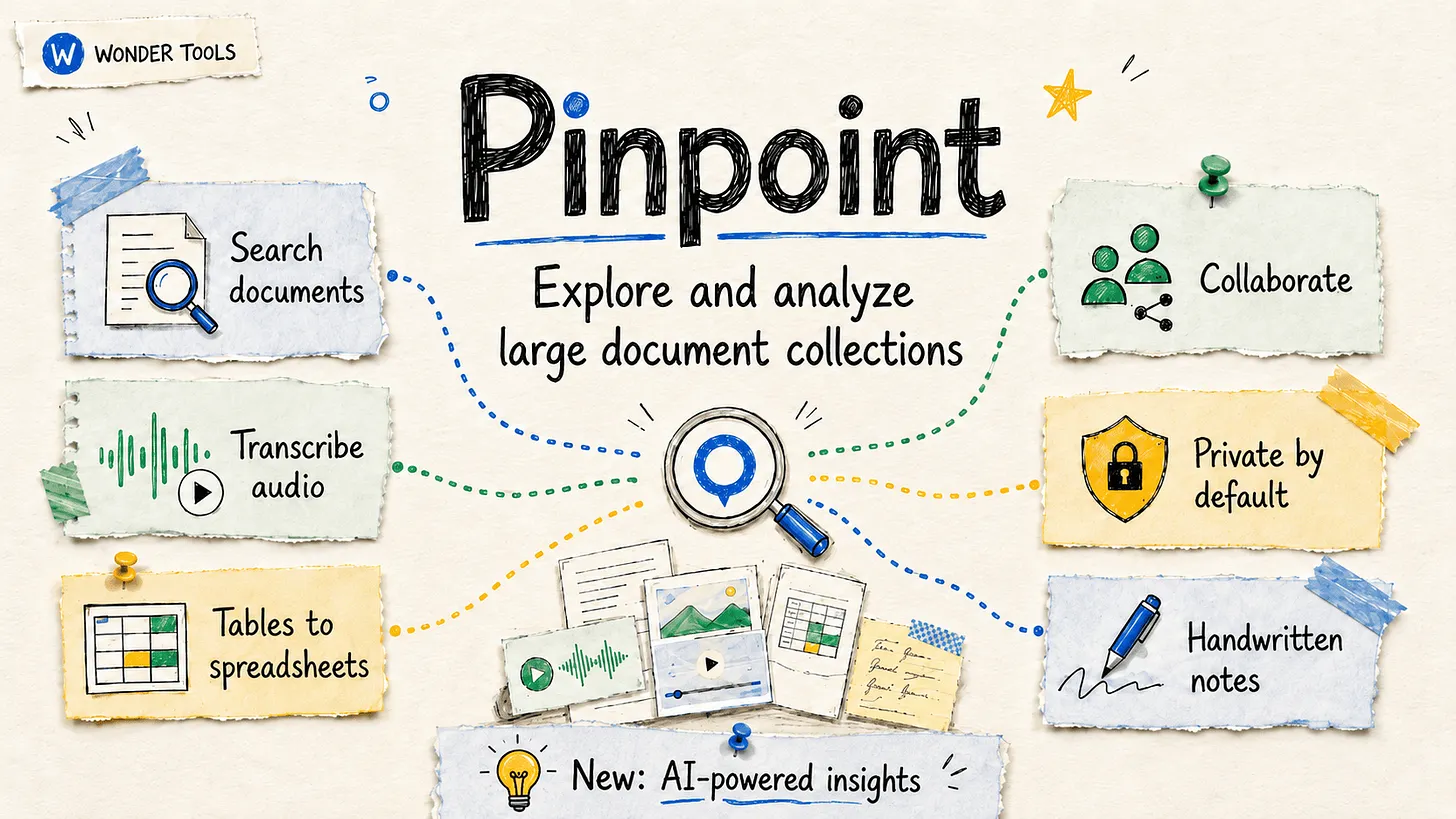
Pinpoint, Explained — from wondertools.substack.com by Jeremy Caplan
A guide to Google’s free tool, now open to all


.Jeremy prompted ChatGPT to generate illustrations in his post.

.


Learn about Pinpoint— from support.google.com

Pinpoint is an AI-powered research platform designed to help journalists and academics analyze large collections of documents. With Pinpoint, you can:

  • Analyze massive collections: Easily search, filter, transcribe and organize thousands of documents, including PDFs, images, and audio files.
  • Leverage generative AI: Use Gemini’s capabilities to answer research questions together with supporting evidence found in your documents.
  • Foster collaborative research: share your work with colleagues and tackle large scale projects as a team. You can also publicly share – supporting community-driven research.

For assistance with Pinpoint, please consult our Community Forum or you can contact our support team.


Addendum:

AI Budgets in Education Show No Sign of Decline — from campustechnology.com by Rhea Kelly

Key Takeaways

  • Education AI budgets are holding steady or increasing: Wasabi found that 98% of education organizations expect AI infrastructure budgets to increase or remain steady, with 46% planning increases.
  • Storage costs are the top AI implementation challenge: Half of education respondents cited data storage issues, including storage and access costs, as the No. 1 challenge for AI projects.
  • Cloud security and ROI remain pressure points: Only 47% feel confident keeping data unaltered and operational after a cyberattack, 44% lost access to public cloud data after an attack, and 37% of AI projects currently show positive ROI.
 

4 Strategies For Teaching With AI Effectively — from techlearning.com by Erik Ofgang
Health sciences professor Humberto López Castillo urges students to use AI to help with science research, but never to lose sight of the human element.

Castillo, a trained pediatrician and professor in the Department of Health Sciences, has also seen students use AI in creative ways to promote public health understanding, and as a research tool. For one project, Castillo asks students to explain health concepts from class to non-experts, and since he started encouraging students to use AI, he’s seen the projects get better. Students have created health-themed board games and Hamilton-style rap songs. Others have designed AI to aid in health research in ways that wouldn’t be possible without the technology.

This compassionate and student-centered approach to AI use is part of why Castillo was named Superhuman (formerly Grammarly’s) 2026 Educator of the Year.
.

.

“You are the one who’s responsible for that writing,” Castillo tells his students. “Your name is the only name that’s going to be among the published authors, so you are the one who needs to verify those sources.”

He adds that rather than being a drawback, allowing students to make these types of mistakes with AI use in the college setting has value.

“It is a teaching opportunity,” Castillo says. “This is the moment to make those mistakes.”


GenAI practice blossoms through the open exchange of insights — from timeshighereducation.com by Samuel Doherty, who is the education and innovation coordinator at the University of Newcastle in Australia
How a structured GenAI professional development series, built around practice, peer voices and multiple entry points, fosters open exchange among colleagues, universities and industry

Connect internal practice to sector-wide thinking
Whatever is happening within any single institution is only part of the picture. Effective GenAI practice grows through open exchange of insights among colleagues, universities, professional bodies and industry, and a development programme that is entirely inward-looking risks missing both useful knowledge and important shifts in expectation.

Our AI sector voices sessions aim to bring external contributors into the programme: researchers, practitioners and sector representatives working at the intersection of GenAI and higher education. The aim is to situate institutional practice within the wider conversation and to signal to staff that the institution is genuinely engaged with that conversation, not just managing it internally.

In the Australian context, the Tertiary Education Quality and Standards Agency (Teqsa) people pillar positions staff as drivers, enablers, users and innovators of GenAI practice, and identifies a lack of information or understanding as one of the primary barriers to ethical and effective engagement. That framing is useful regardless of regulatory context: institutions that treat their people as active participants in shaping practice, rather than recipients of policy, are likely to develop more durable capability.

Regular, lightweight communications, a weekly community of practice update and a monthly all-staff digest can maintain momentum between sessions without adding significantly to anyone’s workload. 


What AI-Enabled Education Actually Looks Like When It’s Working for Workforce Students — from gettingsmart.com by Stephen Griffin

Key Points

  • Institutions can use AI to make skills, pathways, and job outcomes visible to students and employers in ways traditional transcripts cannot.
  • Academic affairs, workforce development, career services, and employers need a shared definition of readiness and competency before tools can deliver meaningful value.

The second is portable competency records. Learning and employment records — AI-enabled documentation of what a student knows and can do, expressed in language employers recognize — are the infrastructure that makes credentials legible across the education-to-employment continuum. When a student can show an employer not just “completed Supply Chain Management 101” but “demonstrated proficiency in inventory optimization, route planning, and logistics software at the industry-recognized level,” the credential stops being abstract. It becomes evidence. Building these records requires investment in tools, yes — but more importantly, it requires faculty, workforce development staff, and employer partners to agree on what competency actually looks like before the technology is ever purchased.


Workplace Readiness: Can Higher Education Develop AI-Ready Students? — from learningguild.com by Eddie Lin and Roshan Bharwaney

For higher education to remain relevant, curricula must evolve. Here are some overarching recommendations for directions in higher education to bridge the skills gaps between universities and workplaces:

  • AI ethics and safety: Prepare students to navigate issues of fairness, bias, privacy, and societal impact.
  • Tackling complex questions: Emphasize open-ended challenges that blend structured and unstructured skills and reduce reliance on standardized tests and repetitive drills.
  • Critical thinking: Develop new assessments for judgment, creativity, and metacognition—essential to supervise AI outputs.
  • Human-AI synergy: Embed AI fluency across all disciplines, encouraging students to find the niches where human value is maximized.
  • Industry connection: Maintain close industry partnerships and collaborations including open innovation opportunities and collective intelligence approaches (Bharwaney & Sleeva, 2024).

Experiential learning and communities of practice are central to this vision. Internships, simulations, and cross-disciplinary projects can help students practice human-AI collaboration, resilience, and decision-making in environments that mirror the workplace’s ambiguity and complexity.

Universities that condemn the use of AI by students risk isolating themselves from the realities of today’s workplace, where interns and new hires are expected to be or quickly become adept at using AI for routine tasks and complex projects. 


Can colleges still deliver in the age of AI? One Ivy League school is investing $30 million to improve career outcomes — from cnbc.com by Jessica Dickler

Key Points

  • College students are increasingly worried about what an AI-driven jobs apocalypse could mean for their employment prospects.
  • To that end, many colleges and universities are racing to recalibrate.
  • Even at nation’s most elite schools, the focus is shifting to career readiness.
 

Mapping the Structural Divide — from kylesaunders.com by Kyle Saunders
Institutional Resilience, Post-College Market Position, and Artificial Intelligence Exposure Across 1,556 U.S. Colleges and Universities

Where does your institution stand?
U.S. four-year colleges and universities face compounding pressures — demographic decline, fiscal stress, and artificial intelligence — that will reshape the sector over the next decade. This project maps where 1,556 institutions are structurally positioned across two dimensions, using federal data anyone can verify.

X-axis: Institutional Resilience
Can this institution absorb financial and enrollment shocks?
Endowment per student · Revenue diversification · Enrollment trend · Admissions selectivity

Y-axis: Post-College Market Position
How well does this institution position graduates for the labor market ahead?
Completion rate · Earnings-to-debt ratio · AI exposure (inverted) · Demographic trajectory


Easy to miss: Anthropic named the Justice Technology Association as the access-to-justice partner in the launch. The cost floor just dropped (while the product got better) for consumer legal. Law Firm 2.0 gets the headlines. A2J and direct-to-consumer is the largest white space in legal.


Antti Innanen > LAVERN: OPEN SOURCE

It has been a crazy 48 hours. We released Lavern as open source.

An agentic legal system, six months in the making, 155,000+ lines of code, 67 specialist agents, nine workflows, and at least ten things inside it that you could make as a separate product.

I was a bit anxious, like I was organising a kids’ party with balloons, unsure if anyone would come.

But they did.


A New Era of Security: Frontier AI Defense — from paloaltonetworks.com by Sam Rubin

For the last several months, we have had early, unbounded access to the latest frontier AI models. What we’ve seen from that vantage point has made it clear that the window for organizations to get ahead of what’s coming is shorter than most leaders realize.

We have moved past the era of incremental AI improvements into a threat landscape shift. Our testing has revealed a step-change in capability that demonstrates an intuitive understanding of software vulnerabilities. This is more than faster code generation, it is a shift from AI as an assistant to AI as an autonomous agent capable of discovering and chaining flaws at a scale that most defenders aren’t prepared for.

These capabilities will not stay confined to controlled environments for long. When Mythos first launched, we predicted a six-month window before attackers gained access. We now believe that timeline has accelerated significantly.


© 2025 | Daniel Christian