Community colleges are training the next generation of manufacturing workers — from manufacturingdive.com by Michelle No
Rutgers University explored how community colleges are responding to regional workforce training demands. Clark State College and Columbus State Community College are among those leading the way.

One underrated option may hold the most promise for workforce growth: the local community college.

That’s according to a series of reports by The Rutgers Education and Employment Research Center released in October, which examines the “hidden innovative structure” of America’s community colleges.

Community colleges excel in ways conducive to a successful manufacturing career, said Shalin Jyotishi, founder of the Future of Work & Innovation Economy Initiative at think tank New America.


Rebuilding The First Rung Of The Opportunity Ladder — from forbes.com by Bruno V. Manno

Two-thirds of employers say most new hires are not fully prepared for their roles, citing “experience,” not technical skill, as the greatest shortfall. At the same time, 61% of companies have raised their experience requirements.

As a result, many so-called entry-level roles now demand two to five years of prior work experience. The first rung of the career ladder has been pulled even farther out of reach for new job seekers. A portfolio—or full-spectrum—model of work-based learning is one promising way to rebuild that rung.

Experience has become what Deloitte calls “the new currency of employability.” But the places where young people once earned that currency are disappearing.


Caring for Patients for 26 Years—and Still Not a Nurse — from workshift.org/ by Colleen Connolly

Arnett’s experience spending decades in a job she intended as a first step is common among CNAs, medical assistants, and other entry-level healthcare workers, many of them women of color from low-income backgrounds. Amid a nationwide nursing shortage, elevating those workers seems like an obvious solution, but the path from CNA to nurse isn’t so much a ladder as it is a huge leap.

And obstacle after obstacle is strewn in the way. The high cost of nursing school, lengthy prerequisite requirements, rigid schedules, and unpaid clinical hours make it difficult for many CNAs to advance in their careers, despite their willingness and ability and the dire need of healthcare facilities.

While there are no national statistics about the number of entry-level healthcare workers who move on to higher-paid positions, a study of federal grants for CNA training showed that only 3% of those who completed the training went on to pursue further education to become an LPN or RN. Only 1% obtained an associate degree or above. A similar study in California showed that 22% of people who completed CNA certificate programs at community colleges went on to get a higher-level educational credential in health, but only 13% became registered nurses within six years.

That reality perpetuates chronic shortages in nursing, and it also keeps hundreds of thousands of healthcare workers locked below a living wage, often for decades.


…the above posting links to:

Higher Ed Is Sleepwalking Toward Obsolescence— And AI Won’t Be the Cause, Just the Accelerant — from substack.com by Steven Mintz
AI Has Exposed Higher Ed’s Hollow Core — The University Must Reinvent Itself or Fade

It begins with a basic reversal of mindset: Stop treating AI as a threat to be policed. Start treating it as the accelerant that finally forces us to build the education we should have created decades ago.

A serious institutional response would demand — at minimum — six structural commitments:

  • Make high-intensity human learning the norm.  …
  • Put active learning at the center, not the margins.  …
  • Replace content transmission with a focus on process.  …
  • Mainstream high-impact practices — stop hoarding them for honors students.  …
  • Redesign assessment to make learning undeniable.  …

And above all: Instructional design can no longer be a private hobby.


Teaching with AI: From Prohibition to Partnership for Critical Thinking — from facultyfocus.com by Michael Kiener, PhD, CRC

How to Integrate AI Developmentally into Your Courses

  • Lower-Level Courses: Focus on building foundational skills, which includes guided instruction on how to use AI responsibly. This moves the strategy beyond mere prohibition.
  • Mid-Level Courses: Use AI as a scaffold where faculty provide specific guidelines on when and how to use the tool, preparing students for greater independence.
  • Upper-Level/Graduate Courses: Empower students to evaluate AI’s role in their learning. This enables them to become self-regulated learners who make informed decisions about their tools.
  • Balanced Approach: Make decisions about AI use based on the content being learned and students’ developmental needs.

Now that you have a framework for how to conceptualize including AI into your courses here are a few ideas on scaffolding AI to allow students to practice using technology and develop cognitive skills.


80 per cent of young people in the UK are using AI for their schoolwork — from aipioneers.org by Graham Attwell

What was encouraging, though, is that students aren’t just passively accepting this new reality. They are actively asking for help. Almost half want their teachers to help them figure out what AI-generated content is trustworthy, and over half want clearer guidelines on when it’s appropriate to use AI in their work. This isn’t a story about students trying to cheat the system; it’s a story about a generation grappling with a powerful new technology and looking to their educators for guidance. It echoes a sentiment I heard at the recent AI Pioneers’ Conference – the issue of AI in education is fundamentally pedagogical and ethical, not just technological.


Is An Internship In College More Important Than The Degree Itself? — from forbes.com by Brandon Busteed

While confidence in higher education has eroded and more Americans are questioning the importance of a degree, the demand for internships among college students is skyrocketing and the odds of getting an internship at a major company are now lower than getting into the Ivy League. This begs the question: are we at a point where an internship is as valuable – or perhaps more so – than a degree itself?

While concerns about degree ROI were on the rise, the value of internships and other work-integrated learning opportunities was becoming increasingly apparent. New research and analysis have shown us how valuable it is for a student to have an internship during college: it doubles the odds they have a good job waiting for them upon graduation and doubles their odds of being engaged in their work over their lifetime. Although there are some variations in those outcomes by choice of college or academic major, those variations pale in comparison to the impact of having an internship. In short, a collegiate internship experience is a more important indicator of these outcomes than alma mater or major.


Entrepreneurship: The New Core Curriculum — from gettingsmart.com by Tom Vander Ark

Key Points

  • Entrepreneurship education fosters resilience, creativity, and financial literacy—skills critical for success in an unpredictable, tech-driven world.
  • Programs like NFTE, Junior Achievement, and Uncharted Learning empower students by offering real-world entrepreneurial experiences and mentorship.

“Entrepreneurship is the job of the future.”

— Charles Fadel, Education for the Age of AI

This shift requires a radical re-evaluation of what we teach. Education leaders across the country are realizing that the most valuable skill we can impart is not accounting or marketing, but the entrepreneurial mindset. This mindset—built on resilience, creative problem-solving, comfort with ambiguity, and the ability to pivot—is essential in startups, as an intrapreuer in big organizations, or as a citizen working for the common good.


Why Co-Teaching Will Be A Hot New Trend In Higher Education — from forbes.com by Brandon Busteed

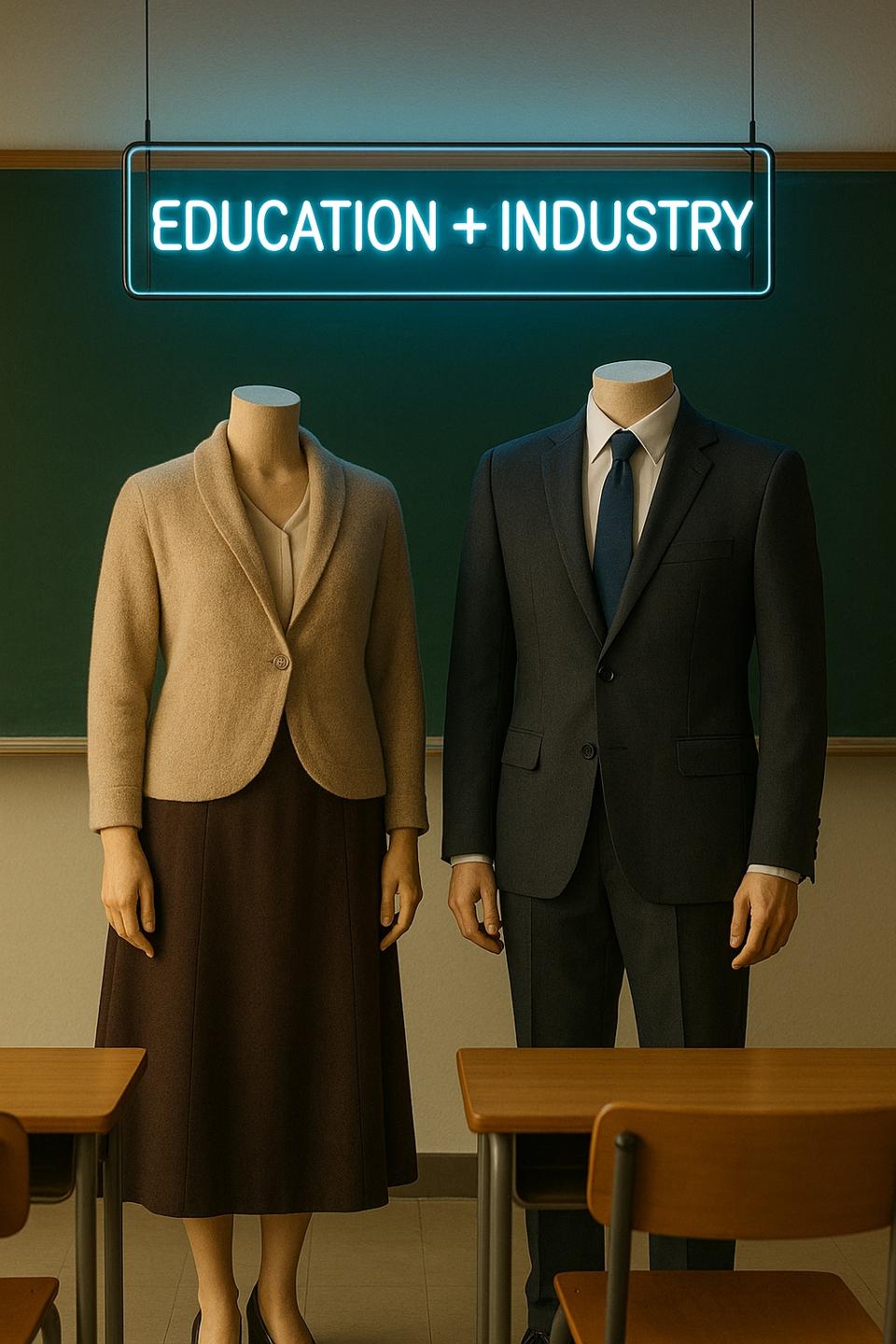
When it comes to innovation in higher education, most bets are being placed on technology platforms and AI. But the innovation students, faculty and industry need most can be found in a much more human dimension: co-teaching. And specifically, a certain kind of co-teaching – between industry experts and educators.

While higher education has largely embraced the value of interdisciplinary teaching across different majors or fields of study, it has yet to embrace the value of co-teaching between industry and academia. Examples of co-teaching through industry-education collaborations are rare and underutilized across today’s higher ed landscape. But they may be the most valuable and relevant way to prepare students for success. And leveraging these collaborations can help institutions struggling to satisfy unfulfilled student demand for immersive work experiences such as internships.


From DSC:
It’s along these lines that I think that ADJUNCT faculty members should be highly sought after and paid much better — as the up-to-date knowledge and experience they bring into the classroom is very valuable. They should have equal say in terms of curriculum/programs and in the way a college or university is run.


Provosts Are a ‘Release Valve’ for Campus Controversy — from insidehighered.com by Emma Whitford
According to former Western Michigan provost Julian Vasquez Heilig, provosts are stuck driving change with few, if any, allies, while simultaneously playing crisis manager for the university.

After two years, he stepped down, and he now serves as a professor of educational leadership, research and technology at Western Michigan. His frustrations with the provost role had less to do with Western Michigan and more to do with how the job is designed, he explained. “Each person sees the provost a little differently. The faculty see the provost as administration, although, honestly, around the table at the cabinet, the provost is probably the only faculty member,” Heilig said. “The trustees—they see the provost as a middle manager below the president, and the president sees [the provost] as a buffer from issues that are arising.”

Inside Higher Ed sat down with Heilig to talk about the provost job and all he’s learned about the role through years of education leadership research, conversations with colleagues and his own experience.


Brandeis University launches a new vision for American higher education, reinventing liberal arts and emphasizing career development — from brandeis.edu

Levine unveiled “The Brandeis Plan to Reinvent the Liberal Arts,” a sweeping redesign of academic structures, curricula, degree programs, teaching methods, career education, and student support systems. Developed in close partnership with Brandeis faculty, the plan responds to a rapidly shifting landscape in which the demands on higher education are evolving at unprecedented speed in a global, digital economy.

“We are living through a time of extraordinary change across technology, the economy, and society,” Levine said. “Today’s students need more than knowledge. They need the skills, experiences, and confidence to lead in a world we cannot yet predict. We are advancing a new model. We need reinvention. And that’s exactly what Brandeis is establishing.”

The Brandeis Plan transforms the student experience by integrating career preparation into every stage of a student’s education, requiring internships or apprenticeships, sustaining career counseling, and implementing a core curriculum built around the skills that employers value most. The plan also reimagines teaching. It will be more experiential and practical, and introduce new ways to measure and showcase student learning and growth over time.


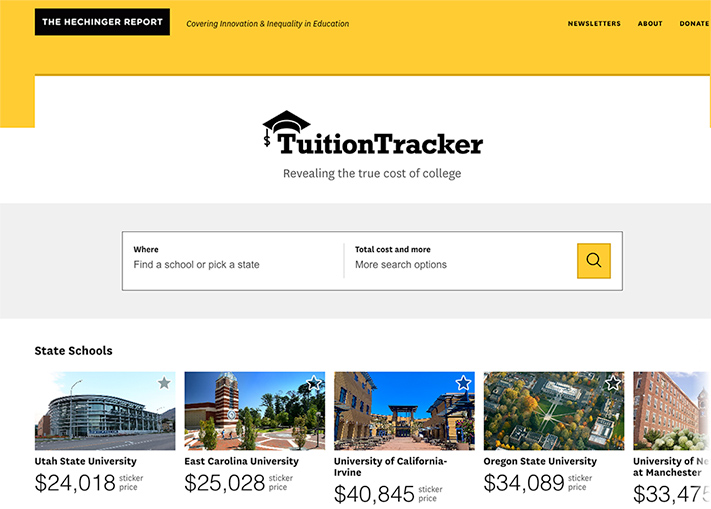
Tuition Tracker from the Hechinger Report


1 in 2 graduates believe their college major didn’t prepare them for today’s market — from hrdive.com by Carolyn Crist
Respondents said they felt unprepared in numerous ways, especially finding a job after graduation and navigating student debt and personal finances.

As today’s college graduates struggle to start a steady career, 1 in 2 Americans say their college major didn’t prepare them for the job market, according to a June 18 report from Preply.

Beyond that, 1 in 6 Americans who went to college said they regret it. When thinking about their college experience, college graduates said their top regrets included taking out student loans, not networking more and not doing internships.

College graduates said they felt unprepared in numerous ways, especially finding a job after graduation and navigating student debt and personal finances. 

From DSC:
The Career Placement Office at Northwestern University did not help build my skills to get a job, at all. I had no clue what I was doing. I had no idea what networking was even about, nor the power of it, and why it would be useful throughout my career. They provided conference rooms for interviews to occur…and that was about it, at least in my experience. In terms of my education, I didn’t get any real-world experience (such as apprenticeships, internships, capstone courses, etc.), nor did I pick up many practical or technical skills. 


Driving Culture Change in Higher Education — from jeffselingo.com by Jeff Selingo

The call for transformation in higher education has never been louder, yet the path forward remains unclear for many institutions. Leaders often struggle with the “how” of meaningful change. This five-part playbook by higher education author and strategist Jeff Selingo as well as other experts draws on proven methodologies to provide clear, actionable guidance from mapping current institutional culture to sustaining long-term momentum.


Employers’ emphasis on skilled trades lost on Gen Z: Harris poll — from facilitiesdive.com
Young workers don’t realize going into the trades can offer good pay more quickly than pursuing a college-based career, the report says.

A mismatch exists between the importance employers are putting on skilled trades and how the generation that’s newly joining the workforce views those jobs, a Harris poll finds.

Gen Z, the oldest members of which are 28, is the age cohort least focused on skilled trades, in part because they’re misinformed about the jobs, says the report based on 2,200 respondents to survey questions posted online in June.

“Only 38% of Gen Z says skilled trades offer the best job opportunities today” and “only 36% strongly agree skilled trades offer a faster and more affordable path to a good career,” the report says.


From DSC:
In looking at
 
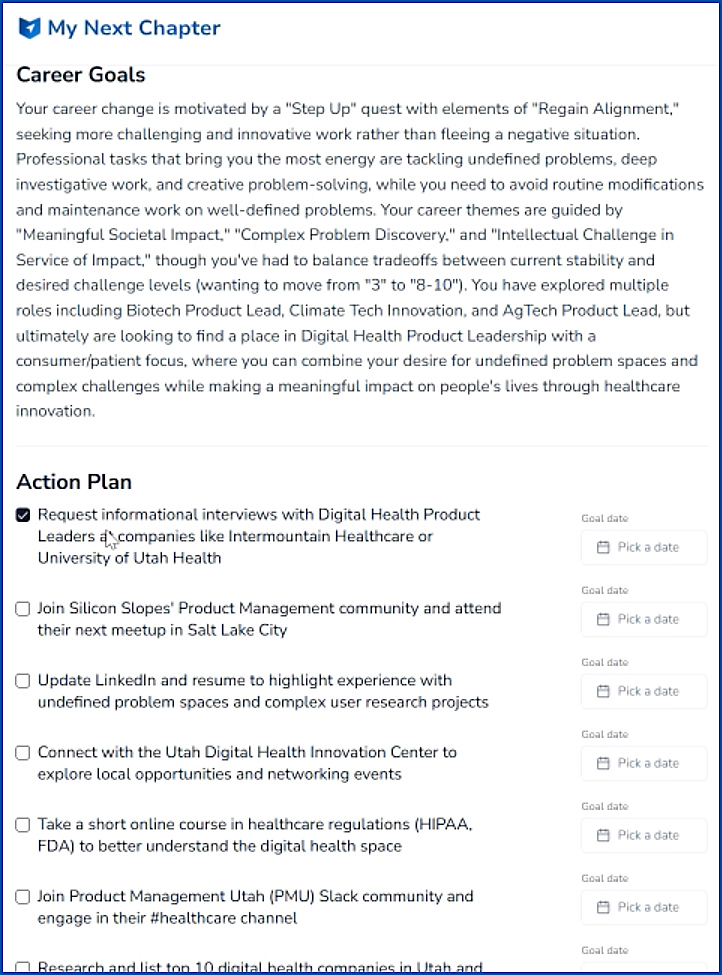
MyNextChapter.ai — THIS TYPE OF FUNCTIONALITY of an AI-based chatbot talking to you re: good fits for a future job — is the kind of thing that could work well in this type of vision/learning platform. The AI asks you relevant career-oriented questions, comes up with some potential job fits, and then gives you resources about how to gain those skills, who to talk with, organizations to join, next steps to get your foot in the door somewhere, etc.

The next gen learning platform would provide links to online-based courses, blogs, peoples’ names on LinkedIn, courses from L&D organizations or from institutions of higher education or from other entities/places to obtain those skills (similar to the ” Action Plan” below from MyNextChapter.ai).


Astronaut one day, artist the next: How to help children explore the world of careers — from apnews.com by Cathy Bussewitz

Sometimes career paths follow a straight line, with early life ambitions setting us on a clear path to training or a degree and a specific profession. Just as often, circumstance, luck, exposure and a willingness to adapt to change influence what we do for a living.

Developmental psychologists and career counselors recommend exposing children to a wide variety of career paths at a young age.

“It’s not so that they’ll pick a career, but that they will realize that there’s lots of opportunities and not limit themselves out of careers,” said Jennifer Curry, a Louisiana State University professor who researches career and college readiness.

Preparing for a world of AI
In addition to exposing children to career routes through early conversations and school courses, experts recommend teaching children about artificial intelligence and how it is reshaping the world and work.


Boys Are Struggling in School. What Can Be Done? — from edweek.org by Rick Hess
Scholar Richard Reeves says it’s time to take a hard look at gender equity

Rick: What kinds of strategies do you think would help?

Richard: In education, we should expand the use of male-friendly teaching methods, such as more hands-on and active learning approaches. We should also consider redshirting boys—starting them in school a year later—to account for developmental differences between boys and girls. We should also introduce more male mentors and role models in schools, particularly in elementary education, where male teachers are scarce. In the workforce, apprenticeship and vocational training programs need to be expanded to create pathways into stable employment for young men who may not pursue a four-year degree. Career counseling should also emphasize diverse pathways to ensure that boys who may not thrive in a traditional academic setting still have opportunities for success. Additionally, fatherhood policies should recognize the importance of male engagement in family life, supporting fathers in their role as caregivers and providers.


While on the topic of K12 education, also see:

How Electives Help All Students Succeed — from edutopia.org by Miriam Plotinsky
Giving students a choice of electives increases engagement and allows them to develop skills outside of core academic subjects.

I recently conducted a student focus group on the topic of school attendance. One of the participants, a high school junior who admitted to being frequently late or absent, explained why she still came to school: “I never want to miss Drama. My teacher is awesome. Her class is the reason I show up every day.” As the rest of the focus group chimed in with similar thoughts, I reflected on the power that elective courses hold for students of all ages.

These courses, from jazz band to yoga, cement students’ sense of self not just in their primary and secondary years, but also in their journey toward adulthood. In these tight economic times, schools or districts often slash electives to save money on staffing, which is highly detrimental to student success. Instead, not only should budget cuts be made elsewhere, but also elective offerings should increase to heighten student choice and well-being.


Learners need: More voice. More choice. More control. -- this image was created by Daniel Christian


Stop Trying to Make Everyone Go to College — from nytimes.com by Randi Weingarten; this is a gifted article

For years, America’s approach to education has been guided by an overly simplistic formula: 4+4 — the idea that students need four years of high school and four years of college to succeed in life.

Even with this prevailing emphasis on college, around 40 percent of high schoolers do not enroll in college upon graduating, and only 60 percent of students who enroll in college earn a degree or credential within eight years of high school graduation.

While college completion has positive effects — on health, lifetime earnings, civic engagement and even happiness — it’s increasingly clear that college for all should no longer be our North Star. It’s time to scale up successful programs that create multiple pathways for students so high school is a gateway to both college and career.

I propose a different strategy: aligning high school to both college prep and in-demand vocational career pathways. Just as students who plan to go to college can get a head start through Advanced Placement programs, high schools, colleges and employers should work together to provide the relevant coursework to engage students in promising career opportunities.


Students Shadow Alumni at Work and at Home — from insidehighered.com by Ashley Mowreader
Learners at Grinnell College can experience a week in the life of a career professional through a homestay job shadow offering.

Job shadows provide students with a low-stakes opportunity to engage in a workplace to gain deeper insight into company culture and daily habits of working individuals.

An externship experience at Grinnell College in Iowa goes one step further and places students in homestays with alumni over spring break, giving them a peek behind the curtain to the work-life balance and habits of alumni in their intended industry.


Who does need college anymore? About that book title … — from Education Design Lab

As you may know, Lab founder Kathleen deLaski just published a book with a provocative title: Who Needs College Anymore? Imagining a Future Where Degrees Won’t Matter.

Kathleen is asked about the title in every media interview, before and since the Feb. 25 book release. “It has generated a lot of questions,” she said in our recent book chat. “I tell people to focus on the word, ‘who.’ Who needs college anymore? That’s in keeping with the design thinking frame, where you look at the needs of individuals and what needs are not being met.”

In the same conversation, Kathleen reminded us that only 38% of American adults have a four-year degree. “We never talk about the path to the American dream for the rest of folks,” she said. “We currently are not supporting the other really interesting pathways to financial sustainability — apprenticeships, short-term credentials. And that’s really why I wrote the book, to push the conversation around the 62% of who we call New Majority Learners at the Lab, the people for whom college was not designed.” Watch the full clip

She distills the point into one sentence in this SmartBrief essay:  “The new paradigm is a ‘yes and’ paradigm that embraces college and/or other pathways instead of college or bust.”

What can colleges do moving forward?
In this excellent Q&A with Inside Higher Ed, Kathleen shares her No. 1 suggestion: “College needs to be designed as a stepladder approach, where people can come in and out of it as they need, and at the very least, they can build earnings power along the way to help afford a degree program.”

In her Hechinger Report essay, Kathleen lists four more steps colleges can take to meet the demand for more choices, including “affordability must rule.”

From white-collar apprenticeships and micro-credential programs at local community colleges to online bootcamps, self-instruction using YouTube, and more—students are forging alternative paths to GREAT high-paying jobs. (source)

 
© 2025 | Daniel Christian