Announcing the 2022 AI Index Report — from hai.stanford.edu by Stanford University

Excerpt/description:

Welcome to the Fifth Edition of the AI Index

The AI Index is an independent initiative at the Stanford Institute for Human-Centered Artificial Intelligence (HAI), led by the AI Index Steering Committee, an interdisciplinary group of experts from across academia and industry. The annual report trackscollatesdistills, and visualizes data relating to artificial intelligence, enabling decision-makers to take meaningful action to advance AI responsibly and ethically with humans in mind.

The 2022 AI Index report measures and evaluates the rapid rate of AI advancement from research and development to technical performance and ethics, the economy and education, AI policy and governance, and more. The latest edition includes data from a broad set of academic, private, and non-profit organizations as well as more self-collected data and original analysis than any previous editions.

Also relevant/see:

  • Andrew Ng predicts the next 10 years in AI — from venturebeat.com by George Anadiotis
  • Nvidia’s latest AI wizardry turns 2D photos into 3D scenes in milliseconds — from thenextweb.com by Thomas Macaulay
    The Polaroid of the future?
    Nvidia events are renowned for mixing technical bravado with splashes of showmanship — and this year’s GTC conference was no exception. The company ended a week that introduced a new enterprise GPU and an Arm-based “superchip” with a trademark flashy demo. Some 75 years after the world’s first instant photo captured the 3D world in a 2D picture…

Nvidia believes Instant NeRF could generate virtual worlds, capture video conferences in 3D, and reconstruct scenes for 3D maps.


Reflections on “Do We Really Want Academic Permanent Records to Live Forever on Blockchain?” [Bohnke]

From DSC:
Christin Bohnke raises a great and timely question out at edsurge.com in her article entitled:
Do We Really Want Academic Permanent Records to Live Forever on Blockchain?

Christin does a wonderful job of addressing the possibilities — but also the challenges — of using blockchain for educational/learning-related applications. She makes a great point that the time to look at this carefully is now:

Yet as much as unchangeable education records offer new chances, they also create new challenges. Setting personal and academic information in stone may actually counter the mission of education to help people evolve over time. The time to assess the benefits and drawbacks of blockchain technology is right now, before adoption in schools and universities is widespread.

As Christin mentions, blockchain technology can be used to store more than formal certification data. It could also store such informal certification data such as “research experience, individual projects and skills, mentoring or online learning.”

The keeping of extensive records via blockchain certainly raises numerous questions. Below are a few that come to my mind:

  • Will this type of record-keeping help or hurt in terms of career development and moving to a different job?
  • Will — or should — CMS/LMS vendors enable this type of feature/service in their products?
  • Should credentials from the following sources be considered relevant?
    • Microlearning-based streams of content
    • Data from open courseware/courses
    • Learning that we do via our Personal Learning Networks (PLNs) and social networks
    • Learning that we get from alternatives such as bootcamps, coding schools, etc.
  • Will the keeping of records impact the enjoyment of learning — or vice versa? Or will it depend upon the person?
  • Will there be more choice, more control — or less so?
  • To what (granular) level of competency-based education should we go? Or from project-based learning?
  • Could instructional designers access learners’ profiles to provide more personalized learning experiences?
  • …and I’m certain there are more questions than these.

All that said…

To me, the answers to these questions — and likely other questions as well — lie in:

  1. Giving a person a chance to learn, practice, and then demonstrate the required skills (regardless of the data the potential employer has access to)
    .
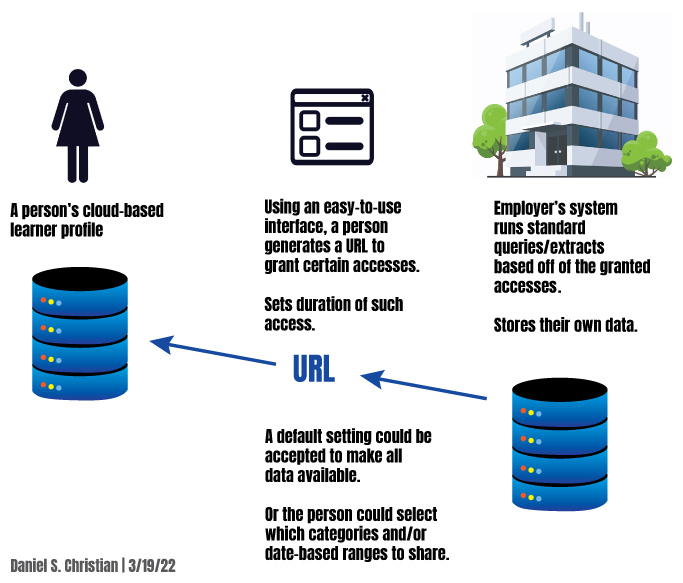
  2. Giving each user the right to own their own data — and to release it as they see fit. Each person should have the capability of managing their own information/data without having to have the skills of a software engineer or a database administrator. When something is written to a blockchain, there would be a field for who owns — and can administer — the data.

In the case of finding a good fit/job, a person could use a standardized interface to generate a URL that is sent out to a potential employer. That URL would be good for X days. The URL gives the potential employer the right to access whatever data has been made available to them. It could be full access, in which case the employer is able to run their own queries/searches on the data. Or the learner could restrict the potential employer’s reach to a more limited subset of data.

Visually, speaking:


Each learner can say who can access what data from their learner's profile


I still have a lot more thinking to do about this, but that’s where I’m at as of today. Have a good one all!


RESULTS ARE IN: HERE ARE THE 15 LEGAL TECH WINNERS OF THE 2022 ABA TECHSHOW STARTUP ALLEY COMPETITION — from techshow.com

Excerpts:

After nearly 32,000 votes, the results are in. Readers have been voting to select the 15 legal technology startups that will get to participate in the sixth-annual Startup Alley at ABA TECHSHOW 2022, taking place March 2-5, 2022.

These 15 will face off in an opening night pitch competition that will be the opening event of this year’s TECHSHOW, with the conference’s attendees voting to pick the top winner. The first-place winner gets a package of marketing and advertising prizes.

Here are the winners in order of their vote tallies. The descriptions were provided by each company.


Companies are making serious money with AI — from sloanreview.mit.edu by Thomas Davenport and Randy Bean

Excerpt:

Just a few years later, things are beginning to change. In the 2022 survey of senior data and technology executives by NewVantage Partners (where Randy Bean is CEO and cofounder, and Tom Davenport is a fellow), 92% of large companies reported that they are achieving returns on their data and AI investments. That’s up markedly from 48% in 2017. The same percentage (92%) said that they are increasing investments in data and AI, equaling last year’s percentage.


Google wants 20,000 Americans to have higher-paying jobs — from protocol.com by Amber Burton
Google’s Career Certificate Fund is aimed at creating a sustainable model of support for American job seekers.

Excerpt:

The program is designed for students to pay zero upfront costs for the three to six-month courses, but Google certificate students are expected to repay program costs if they land a job that pays at least $40,000 annually. While the exact amount of the monthly payments was not shared in the announcement, Google said it will be low no-interest payments for Social Finance to reinvest in the program for additional participants.

Our new $100 million Google Career Certificates Fund — from blog.google by Sundar Pichai

It’s another promising example of how the entire ecosystem — from private companies to nonprofits — can work together to help more Americans access economic opportunities.

Addendum on 3/2/22:


Python, Java, Linux and SQL: These are the hot tech skills employers are looking for — from zdnet.com by Owen Hughes
Programming languages continue to dominate jobs specs, with employers keen to build up their tech teams and deliver on expanding digital programmes.

In Q3, job listings in the tech industry suggest that organizations are on the lookout for technology professionals “who understand the core concepts of software development and project management” and possess technical skills in Linux, as well as programming languages Java, Python and SQL.


Americans Need a Bill of Rights for an AI-Powered World — from wired.com by Eric Lander & Alondra Nelson
The White House Office of Science and Technology Policy is developing principles to guard against powerful technologies—with input from the public.

Excerpt (emphasis DSC):

Soon after ratifying our Constitution, Americans adopted a Bill of Rights to guard against the powerful government we had just created—enumerating guarantees such as freedom of expression and assembly, rights to due process and fair trials, and protection against unreasonable search and seizure. Throughout our history we have had to reinterpret, reaffirm, and periodically expand these rights. In the 21st century, we need a “bill of rights” to guard against the powerful technologies we have created.

Our country should clarify the rights and freedoms we expect data-driven technologies to respect. What exactly those are will require discussion, but here are some possibilities: your right to know when and how AI is influencing a decision that affects your civil rights and civil liberties; your freedom from being subjected to AI that hasn’t been carefully audited to ensure that it’s accurate, unbiased, and has been trained on sufficiently representative data sets; your freedom from pervasive or discriminatory surveillance and monitoring in your home, community, and workplace; and your right to meaningful recourse if the use of an algorithm harms you. 

In the coming months, the White House Office of Science and Technology Policy (which we lead) will be developing such a bill of rights, working with partners and experts across the federal government, in academia, civil society, the private sector, and communities all over the country.

Technology can only work for everyone if everyone is included, so we want to hear from and engage with everyone. You can email us directly at ai-equity@ostp.eop.gov


Higher Education Needs to Move Toward Mass-Personalization — from fierceeducation.com by Susan Fourtané

Excerpt:

Every industry, from health sciences to marketing to manufacturing, is using Artificial Intelligence (AI) to facilitate the delivery of mass-personalization, yet education has been slow in its adoption. These smart systems create personalized solutions targeted to meet the unique needs of every individual.

Artificial Intelligence-based technologies have the potential of serving as tools for educators to provide personalized learning. However, for mass-personalization to work, institutions first need to align their leadership. In his feature session What Is It Going to Take to Move from Mass-Production to Mass-Personalization?, during the recent Online Learning Consortium virtual event, Dale Johnson, Director of Digital Innovation at Arizona State University, addressed the issue of mass personalization in higher education.

Johnson reinforced the idea that with mass-personalization professors can deliver the right lesson to the right student at the right time.

Mass-personalization software does not replace the professor. It makes the professor better, more focused on the students.


How tech will change the way we work by 2030 — from techradar.com by Rob Lamb
Everyday jobs will be augmented by technology

Technologies like Artificial Intelligence (AI), Machine Learning (ML) and Blockchain will have a significant impact on work in the next decade and beyond. But if you believe the sci-fi hype or get bogged down in the technology, it can be difficult to relate them to today’s workplaces and jobs.

Excerpt:

Here are three everyday examples of their potential, expressed in terms of the business challenge they are addressing or how consumers will experience them. I don’t mean to over simplify – these are powerful tools – but I think their potential shines through best when they’re expressed in their simplest terms.

From DSC:
I have an issue with one of their examples that involves positioning AI as the savior of the hiring process:

The problem with this process isn’t just that it’s hugely time-consuming, it’s that all kinds of unconscious biases can creep in, potentially even into the job advert. These issues can be eradicated with the use of AI, which can vet ads for gendered language, sort through applicants and pick out the most suitable ones in a fraction of the time it would take an HR professional or any other human being.

AI can be biased as well — just like humans. Lamb recognizes this as well when he states that “Provided the algorithms are written correctly, AI will be key to organisations addressing issues around diversity and inclusion in the workplace.” But that’s a big IF in my mind. So far, it appears that the track record isn’t great in this area. Also, as Cathy O’Neil asserts: “Algorithms are opinions embedded in code.”

AI may not be as adept as a skilled HR professional in seeing the possibilities for someone. Can person A’s existing skillsets be leveraged in this new/other position?


The Story is in the Structure: A Multi-Case Study of Instructional Design Teams — from the Online Learning Consortium by Jason Drysdale (other articles here)

Excerpt:

Given the results of this study, it is recommended that institutions that are restructuring or building new instructional design teams implement centralized structures with academic reporting lines for their teams. The benefits of both centralization and academic reporting lines are clear: better advocacy and empowerment, better alignment with the pedagogical work of both designers and faculty, and less role misperception for instructional designers. Structuring these teams toward empowerment and better definitions of their roles as pedagogy experts may help them sustain their leadership on the initiatives they led, to great effect, during the COVID-19 pandemic. This study also revealed the importance of three additional structural elements: appropriate instructional design staffing for the size and scale of the institution, leadership experience with instructional design, and positional parity with faculty.

Also see:

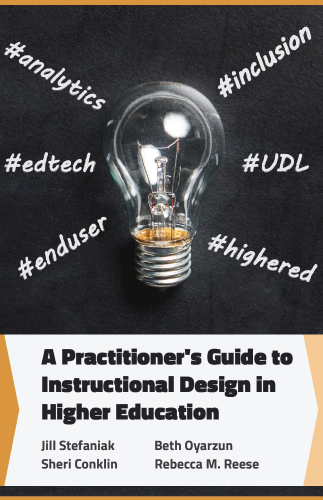
A Practitioner's Guide to Instructional Design in Higher Education


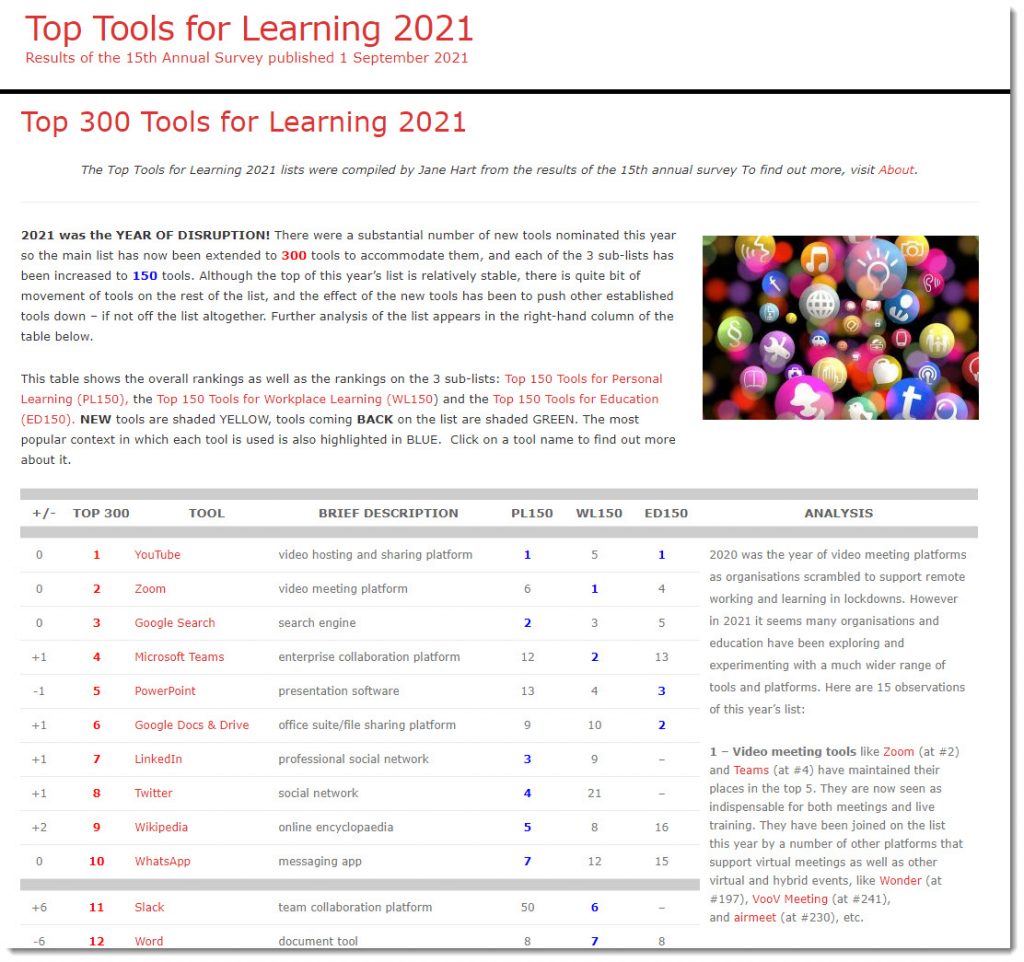
Top 300 Tools for Learning 2021 [Hart]

Top 300 Tools for Learning 2021 — from toptools4learning.com by Jane Hart

Excerpt:

2021 was the YEAR OF DISRUPTION! There were a substantial number of new tools nominated this year so the main list has now been extended to 300 tools to accommodate them, and each of the 3 sub-lists has been increased to 150 tools. Although the top of this year’s list is relatively stable, there is quite bit of movement of tools on the rest of the list, and the effect of the new tools has been to push other established tools down – if not off the list altogether. Further analysis of the list appears in the right-hand column of the table below.

This table shows the overall rankings as well as the rankings on the 3 sub-lists: Top 150 Tools for Personal Learning (PL150), the Top 150 Tools for Workplace Learning (WL150) and the Top 150 Tools for Education (ED150). NEW tools are shaded YELLOW, tools coming BACK on the list are shaded GREEN. The most popular context in which each tool is used is also highlighted in BLUE.  Click on a tool name to find out more about it.


Top 300 Tools for Learning 2021 -- from Jane Hart


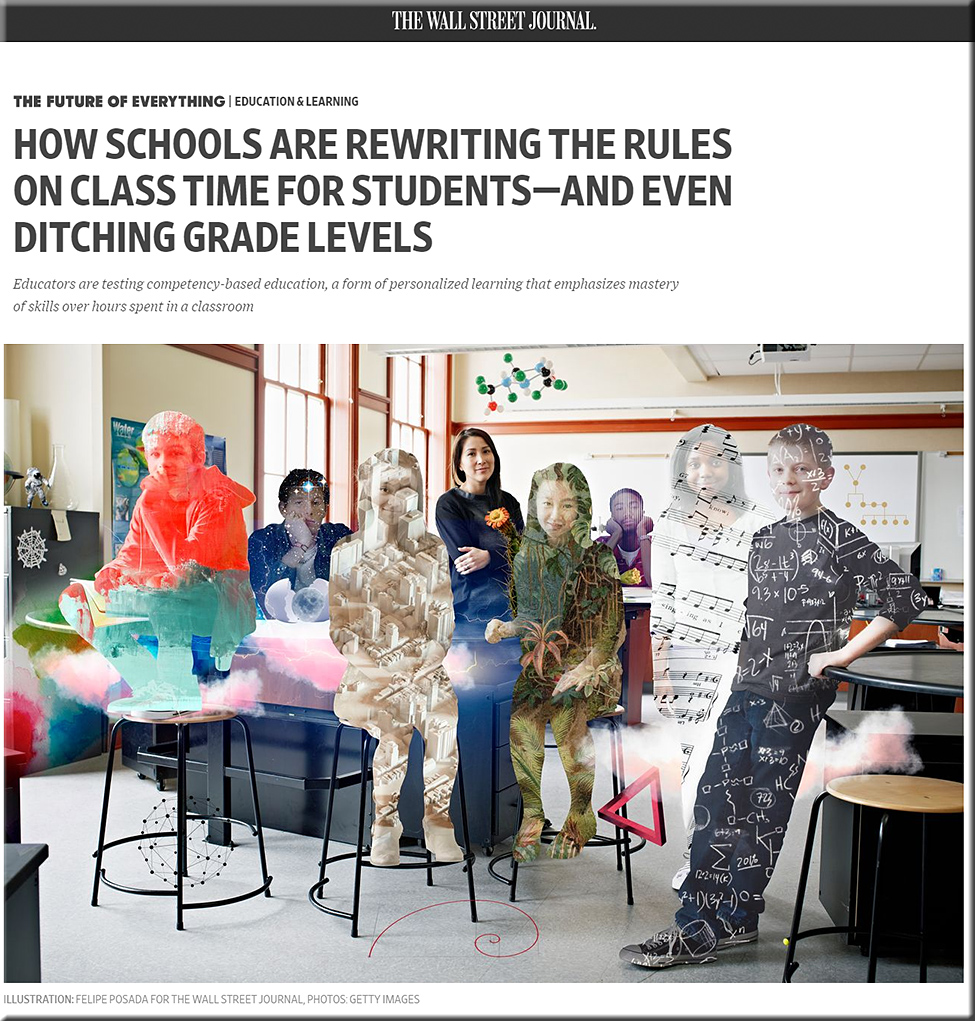
HOW SCHOOLS ARE REWRITING THE RULES ON CLASS TIME FOR STUDENTS—AND EVEN DITCHING GRADE LEVELS — from wsj.com by Yoree Koh
Educators are testing competency-based education, a form of personalized learning that emphasizes mastery of skills over hours spent in a classroom


11 Emerging Business Opportunities In The Internet Of Things Sector — from forbes.com by a panel of Young Entrepreneur Council members

Excerpt (emphasis DSC):

With this increased revenue comes a number of new ways for businesses to leverage IoT technology. Below, a panel of Young Entrepreneur Council members shared some business opportunities they see emerging in the IoT sector. Keep an eye out for these 11 growing trends in the B2B IoT space.

1. Voice-Powered Technologies
With the growing popularity of IoT devices, the interaction of business with customers is also changing. Take for instance Siri, Alexa and Cortana — who are advanced voice technologies — to perform countless searches as the customer orders. This one area of IoT is going to expand gigantically in the future.

 
© 2025 | Daniel Christian