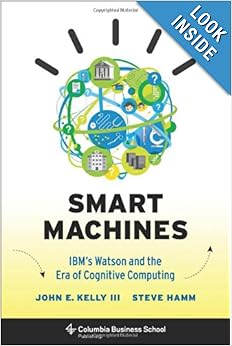
Smart Machines: IBM’S Watson and the era of cognitive computing — from cup.columbia.edu by John E. Kelly III, Director of IBM Research, and Steve Hamm, writer at IBM and former business and technology journalist

Excerpt (emphasis DSC):

Computers today are brilliant idiots. They have tremendous capacities for storing information and performing numerical calculations-far superior to those of any human. Yet when it comes to another class of skills, the capacities for understanding, learning, adapting, and interacting, computers are woefully inferior to humans; there are many situations where computers can’t do a lot to help us.

…

But the goal is not to replicate human brains or replace human thinking with machine thinking. Rather, in the era of cognitive systems, humans and machines will collaborate to produce better results, each bringing its own skills to the partnership. The machines will be more rational and analytic-and, of course, possess encyclopedic memories and tremendous computational abilities. People will provide judgment, intuition, empathy, a moral compass, and human creativity.


From DSC:
Consider what Watson “read in” to come up with some recommendations:
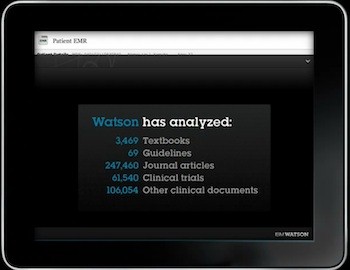
 

Watson


Addendum on 10/14/13 (emphasis DSC):

Watson is being used to assist with the treatment of cancer patients. According to an article from medicalnewstoday.com, Watson is “revolutionizing cancer care and research and speeding up progress for patients.”

In that same article, it mentions that, so far, Watson has ingested:

  • Over 600,000 pieces of medical evidence
  • 2,000,000 pages of text from 42 academic journals and clinical trials based on oncology research
  • A huge number of patients’ records spanning decades of cancer treatment history, including medical records and patient outcomes. Watson can sift through 1.5 million pieces of such records and provide doctors with evidence-based treatment options within seconds.

One of IBM’s General Managers who works with Watson said:

“breakthrough capabilities bring forward the first in a series of Watson-based technologies, which exemplifies the value of applying big data and analytics and cognitive computing to tackle the industry’s most pressing challenges.”
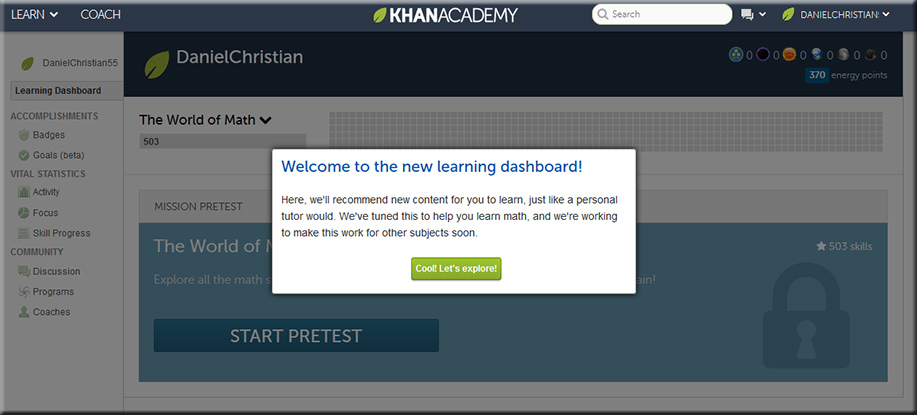
 

Introducing…the Learning Dashboard — from khanacademy.org

Excerpt:

The new learning dashboard is your personal homepage on Khan Academy. The dashboard gives you an easy way to find the best next things for you to do. It has a bunch of really cool things designed to help you learn math, and soon other subjects, really well on your own or with a coach. You can access it when you’re signed in by clicking on the Khan Academy logo at the top of the page.


KhanAcademy-NewLearningDashboard-Sept2013


From DSC:
Think of the power of this in a blended learning environment!  Use the dashboard to gain more choice, more control. See your progress.  Then go to your teacher, professor, trainer, supervisor, subject matter expert, etc. to get guidance, extra help, etc.   It also plays into what I envision in the “Learning from the Living [Class] Room” environment that continues to form in front of our very eyes.


Purdue software boosts graduation rate 21 percent — from purdue.edu

Excerpt:

WEST LAFAYETTE, Ind. – A data-mining and analysis software program called Signals developed by Purdue University has increased six-year graduation rates by 21.48 percent, according to a recent review of data from the 2007 cohort of students.

The increased graduation rates were for students who were in two or more Signals-enabled classes compared to students who had not taken any Signals-enabled courses. Students who had taken just one Signals-enabled course graduated 20.87 percent higher than those who had taken none.

…

The Signals software looks at students’ online academic behaviors, such as whether they opened a reading assignment or completed a set of math exercises. It combines this information with demographic information about the student, such as his or her standardized test scores, high school GPA, and current grades. In all the system uses more than 20 reference datapoints.

Signals then displays a simple and intuitive red, yellow or green signal on the student’s course website to let them know how they are doing in that course.


From DSC:
It seems to me that this is the type of underlying technology/toolset that holds enormous potential for online and blended learning environments. It’s similar to what IBM’s Watson seems to be doing for determining effective plans of action for cancer patients.  The software takes in data from numerous different areas to form a list of the most potentially-effective plans of action (along with the %’s of how likely those items are the causes of actual concern).


watson

Above graphic from:
IBM’s Watson interns at Memorial Sloan-Kettering


Also see:

IBM’s Watson supercomputer to diagnose patients
Watson will initially be used to help treat cancer patients

Excerpt (emphasis DSC):

“The implications for healthcare are extraordinary,” said Lori Beer, WellPoint’s executive vice president of Enterprise Business Services. “We believe new solutions built on the IBM Watson technology will be valuable for our provider partners, and more importantly, give us new tools to help ensure our members are receiving the best possible care.”


Addendums on 9/27:


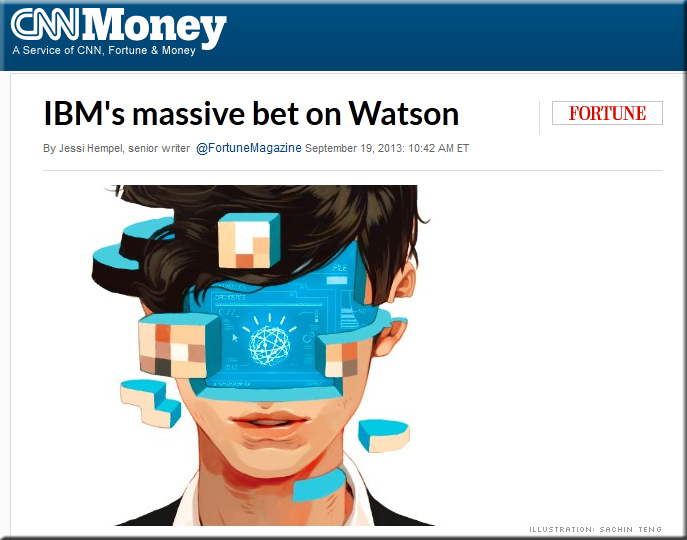
IBMsMassiveBetOnWatson-9-2013


IBM’s big data education outreach — from InformationWeek.com by Ellis Booker; with thanks to EducationDive for their posting this
In the last decade, IBM has partnered with more than 1,000 universities to increase the world’s pool of computer science graduates.  Latest focus: Big data.

Excerpt (emphasis DSC):

The scarcity of data scientists is a problem for platform and tools vendors like IBM.

Even with impressive improvements in data visualization tools such as dashboards, IBM’s customers need employees able to set up these systems, correctly interpret their output and discuss it with business-side colleagues.

IBM and other technology companies themselves need new workers, trained in the latest data-science concepts and techniques. Like many of its customers, IBM is having trouble hiring enough data scientists.

For both of these reasons, IBM has been working closely with colleges and universities. Its educational partnerships now number more than 1,000 globally.


Also see:


True personalization is the next big thing in multiscreen TV — from .v-net.tv by John Moulding


From DSC:
Not a far stretch to see some applications of this in the future aimed at learning objects/learning agents/and personalized streams of content.


The Living [Class] Room -- by Daniel Christian -- July 2012 -- a second device used in conjunction with a Smart/Connected TV


Addendum:
(With thanks going out to Mr. Richard Byrne over at the Free Technology for Teachers blog for this item
)


SchoolsWorldTV-Sept2013


Content as a Service (CaaS) — from knowledgestarblog.wordpress.com by David Grebow

Excerpt:

The etextbook in 2018 will be dramatically different than the etextbook of today. It will be coupled to an app that will provide you with Content as a Service (CaaS). CaaS will include many of the following features (and more that have yet to be imagined):

  • Multimedia
  • Simulations
  • Educational Games
  • Animations
  • Pre- and post-tests
  • Formative and Summative Quizzes
  • Adaptive testing
  • Networked Social Learning
  • Study groups
  • Analytic Datasets
  • Virtual and Flipped classes
  • Communities of Learning and Practice
  • Virtual classes.


Also see:

.

ContentAsAService-Grebow-May2013


IBM and USTA captivate tennis fans with immersive second screen experience — from MarketWatch.com
Analytics, cloud, mobile and social computing technologies deliver US Open to fans’ fingertips


Excerpt:

The innovative digital US Open environment provides fans, players, broadcasters and media with access to a range of Big Data insights streaming from the courts, including stats, facts, videos, live scoring, and historical and real-time analysis of tennis data served to tablets, smartphones, PCs and other devices.


Also see:

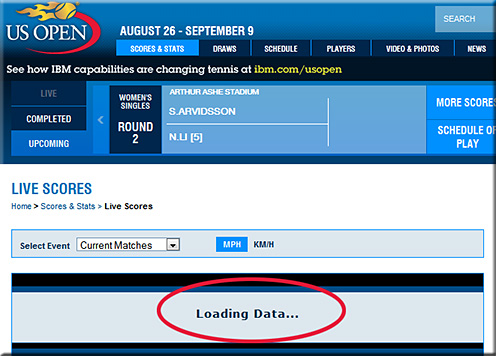
USOpen-USTA-IBM-Aug2013


.

USOpen2-USTA-IBM-Aug2013


From DSC:
Questions I wonder about:

  • How might this sort of thing help us in education? What if, instead of a tennis match, it was a debate on X vs. Y…?
    .
  • Could we use it in educational gaming apps?
    .
  • If so, what sorts of apps that lean on social learning could we create?
    .
  • How could professional development/conferences use this type of immersive second screen experience? What sorts of opportunities for participation would open up?
    .
  • Could we develop things like this that help us learn things IN REAL TIME from the streams of content flowing by? (Do learning agents employ this sort of thing?)


Somewhat-related items:

College students bring targeted media to doctors’ waiting rooms — from entrepreneur.com by Michelle Goodman

Excerpt:

Their idea was to sell doctors’ offices prepackaged video segments containing tips on diet, exercise and other lifestyle tweaks patients could make to improve their health. A TV screen in the reception area would broadcast this programming, modeled after segments on shows such as Today, while patients waited for appointments.

To test the idea, Agarwal, Shah and classmate Derek Moeller bought TVs and DVD players, culled content from the internet and distributed the equipment and “shows” to 50 doctors in five states.

MOOCing the Liberal Arts? Technology and Relationship in Liberal Arts Education
The Thirteenth Annual Conversation on the Liberal Arts
February 13 – 15, 2014
 

IBM cranks up big data analytics training programs as government continues cloud moves [infographic] — from cmswire.com by David Roe

Excerpt (emphasis DSC):

IBM is clearly concerned about the big data skills shortage. It has announced the addition of another 9 universities to its big data training program. The economic importance of the program was also underlined this week by the announcement that it has just secured a US$ 1 billion federal contract for cloud computing.

Big Data, Analytics Skills Shortages

The problem for IT giants that are currently muscling into the big data market is that the development of the technology has been so rapid the number of big data/analytics projects currently underway far outweighs the number of people that have appropriate skills.

In fact between now and the end of 2015, IBM estimates that there will be 4.4 million jobs worldwide in big data support. At the moment it is not clear where all the people required to fill these positions are going to come from.


Introducing…the Learning Dashboard — from khanacademy.org on Thu, 15 Aug 2013


Introducing the learning dashboard!

Excerpt:

The new learning dashboard is your personal homepage on Khan Academy. The dashboard gives you an easy way to find the best next things for you to do. It has a bunch of really cool things designed to help you learn math, and soon other subjects, really well on your own or with a coach.


From DSC:
This is the type of innovation that makes online/blended learning even more powerful/useful.


The NYT just made it way easier to remix its journalism — from by Robinson Meyer
Bringing the simple power of logic (if! then!) to the social web


nytifttt_header.jpg


Excerpt (emphasis DSC):

The New York Times has now opened a channel at the website If This, Then That (IFTTT). For journalism hackers and tinkering readers, this is fine news.

IFTTT is elegantly useful and usefully elegant. For a variety of sites and services (Evernote! Instagram! Dropbox!), IFTTT combines “triggers” and “actions,” so that when one thing happens on one service, something else happens on another.  You can say, if I take a picture on Instagram, then automatically save it to Dropbox.

Or: If my Facebook profile picture changes, then (automatically) change my Twitter picture too.

It even connects to SMS, so you can say: If it begins to rain in my zipcode, then text me about it.


From DSC:
How might this concept be used in conjunction with digital playlists/learning? If I finished the XYZ module over here at U of X, then start ABC over here at ___.


Apple gears up for the video discovery wars — from fastcolabs.com by Michael Grothaus
Think Apple’s Matcha.tv acquisition was about its programming guide service? You’re probably wrong. There’s a new war brewing in online video: helping users find the stuff they want.


From DSC:
Instead of discovering videos only, how about discovering items along the lines of what you are trying to learn more about? i.e. Matcha.tv meets Google Alerts meets IBM’s Watson.


The Coming Big Data Education Revolution — from by Doug Guthrie
Big data, not MOOCS, will give institutions the predictive tools they need to improve outcomes for individual students

Excerpt (emphasis):

Don’t get me wrong, online learning will fundamentally transform higher education, bridging distances and creating access in ways that have not been possible before. But, in this arena, MOOCs are not a transformative innovation that will forever remake academia. That honor belongs to a more disruptive and far-reaching innovation – “big data.” A catchall phrase that refers to the vast numbers of data sets that are collected daily, big data promises to revolutionize online learning and, in doing so, higher education.

Big data in the online learning space will give institutions the predictive tools they need to improve learning outcomes for individual students. By designing a curriculum that collects data at every step of the student learning process, universities can address student needs with customized modules, assignments, feedback and learning trees in the curriculum that will promote better and richer learning.


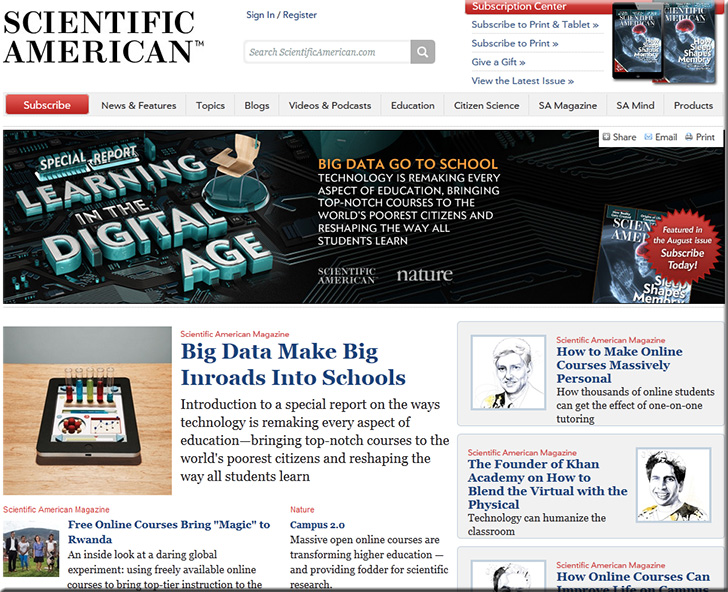
ScientificAmerican-LearningInDigitalAge-August2013


Also see:

  • A “Napster Moment” in Education — from news.yahoo.com
    Excerpt:
    Digital education is like whitewater rafting. Or like the Napster era in music. The two analogies were among many that came up yesterday as panelists considered the future of technology in education at a Scientific American and Macmillan Science & Education summit on “Learning in the Digital Age,” at Google’s New York headquarters.
 

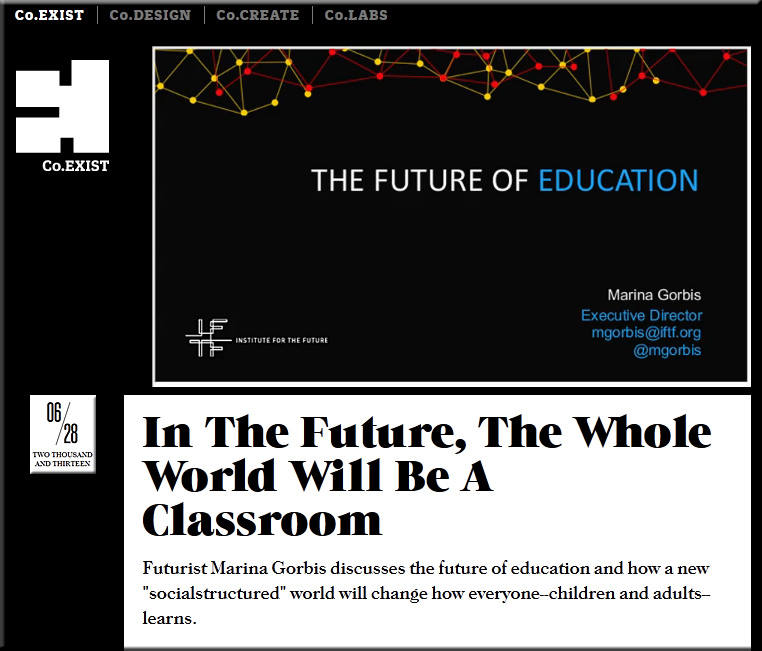
In the future, the whole world will be a classroom — from fastcoexist.com by Marina Gorbis


TheFutureOfEducation-Gorbis-6-28-13

. TheFutureOfEducation3-Gorbis-6-28-13.

From DSC:
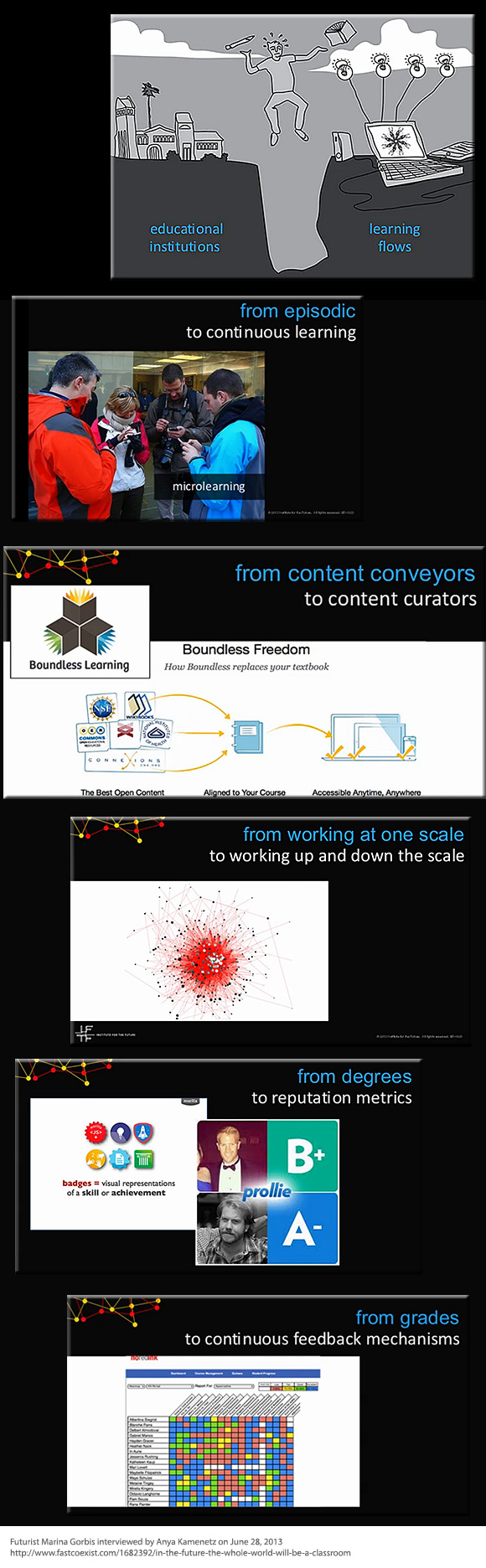
What Marina is asserting is what I’m seeing as well. That is, we are between two massive but different means of obtaining an education/learning (throughout our lifetimes I might add).  What she’s saying is also captured in the following graphic:

.

streams-of-content-blue-overlay


Also see:


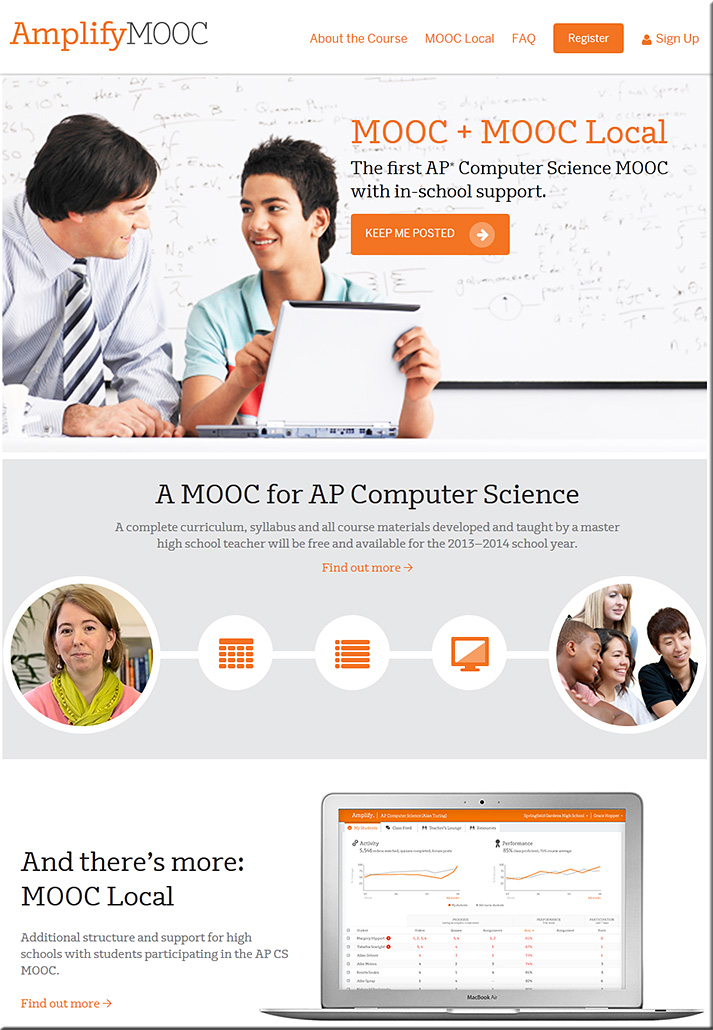
AmplifyMOOC-July2013

.

Also see:

Engineers: This is how and why you need a free ‘big data’ education — from venturebeat.com by Esther Perez

Excerpt:

Additionally, most engineers, myself included, were trained before the rise of the big data ecosystem. There were no courses in our respective engineering schools on Hadoop, and we didn’t receive specialized training on HBase or Hive. While there’s a growing group of recent engineering graduates that had the luxury of learning these skills in university, the majority of engineers out there today still predate the rise of big data.

In an effort to attract top engineering students, a growing number of high-profile universities – Harvard, MIT and Columbia among them – have begun to incorporate big data and data science-centric majors. While this does in theory make it easier for mid-career engineering professionals to gain the requisite skills needed to stay competitive in a fast-changing field, it’s not always so simple.

Taking the necessary time and resources to pause your career and go back to school for one or two years is an extremely risky professional move for most; it’s not as if your employer is simply going to wait two years for you to complete a program and hand your job back once you have a degree in hand.

There is an alternative to this approach, however. A growing number of online learning platforms aimed at providing technical training and certification have appeared in recent years. Some notable examples include Coursera, Khan Academy and Big Data University, all of which are free of charge (a stark contrast to the wave of for-profit “universities” that had previously dominated the online education landscape).


From DSC:
Is this a piece of where higher education is heading?


Here’s why the TV apps economy will be a $14 billion business [Wolf]

Here’s why the TV apps economy will be a $14 billion business — from forbes.com by Michael Wolf


.

Excerpt:

According to new research published this week, the TV apps economy is forecasted to reach $14 billion by 2017.

…

Take for example today’s news that Apple will begin selling video advertisements served by iAd through iTunes Radio loaded on Apple TVs. This is only the first move for Apple in this space, and others like Samsung and Google  are already investing heavily in connected TV app advertising.


From DSC:
Why post this? Because:

  • It lays out future directions/careers related to Programming, Computer Science, Data Mining, Analytics, Marketing, Telecommunications, User Experience Design, Digital and Transmedia Storytelling, and more
    .
  • It leads to “Learning from the Living [Class] Room”

.


The Living [Class] Room -- by Daniel Christian -- July 2012 -- a second device used in conjunction with a Smart/Connected TV


From DSC:
And if this does take off,
$14 billion won’t begin to capture the profits from this new industry.

It will be far larger than that.


Relevant addendum on 6/27/13:

  • The future of cinema is on demand — from bitrebels.com by Ben Warner (From DSC: Having just paid $32 for 4 people — 3 of whom were kids — to see Monsters U, I believe it!)
    .

future-of-cinema-on-demand

Via: [The Verge] Image Credits: [Venture Beat] [Home Theater]


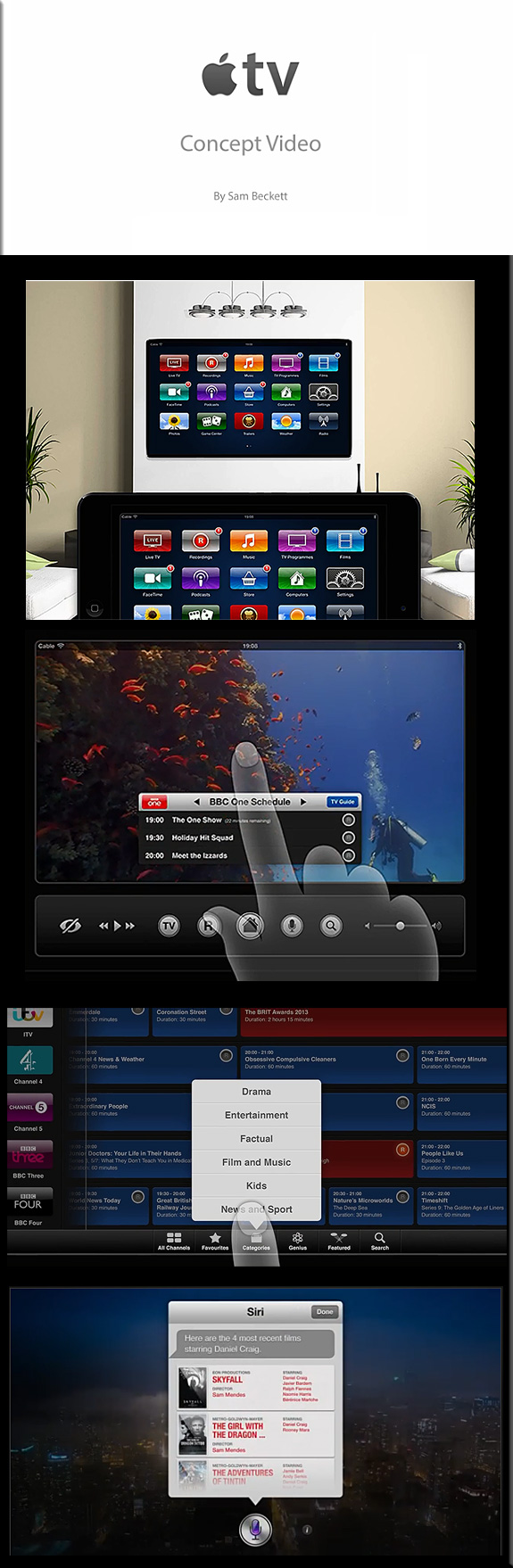
Heads up Jony Ive! You need to see this brilliant concept for the Apple TV! Superb work by Sam Beckett!

BrilliantTVConceptBySamBeckett-May2013


.

From DSC:
Now picture this from the educational standpoint — and what MOOCs could morph into.  The foundation for some serious learning power (from the living room) seems to be developing!

Streams of content/learning channels/cloud-based applications that each of us can create and make available.

Voice recognition, learning analytics, machine-to-machine communications, transmedia and more!  Wow!


.


The Living [Class] Room -- by Daniel Christian -- July 2012 -- a second device used in conjunction with a Smart/Connected TV


© 2025 | Daniel Christian