FutureFit AI Announces Strategic Investment to Help Governments and Industries Navigate AI’s Impact on People & Jobs — from prnewswire.com; via Ryan Craig

NEW YORKApril 13, 2026 /PRNewswire/ — FutureFit AI, a global leader in AI-powered workforce development technology, today announced an investment from Achieve Partners, led by investor and author Ryan Craig,  to accelerate its mission of helping more people navigate to better jobs faster and cheaper at scale.

“For too long, the U.S. workforce system has relied on disparate and disconnected systems to try to bridge the gap between the skills workers bring to the table, and the jobs available in a fast-changing labor market. In the age of AI, the need for a better approach has only become more urgent,” said Ryan Craig, co-founder and managing director of Achieve and author of Apprentice NationA New U, and College Disrupted. “FutureFit AI is solving that problem by helping workforce organizations create clearer paths to career opportunity for workers and solve pressing talent gaps that hinder economic growth. Their work around the country has already demonstrated the ability to help more people get good jobs faster.”

“A mission that began with a simple question of ‘What if everyone had a GPS for their career’ has turned into years of working closely with government and industry leaders to respond to – and solve for – the impacts of digital transformation and AI on jobs and people,” added Ekhtiari. “Our partnership with Achieve will accelerate our work to build and scale the missing workforce transition infrastructure that our country and the world so badly need at this moment.”


Why Sal Khan’s AI revolution hasn’t happened yet, according to Sal Khan — from chalkbeat.org by Matt Barnum

Three years ago, as Khan Academy founder Sal Khan rolled out an AI-powered tutoring chatbot, he predicted a revolution in learning.

So far, the revolution hasn’t happened, he acknowledges.

“For a lot of students, it was a non-event,” Khan told me recently about his eponymous chatbot, Khanmigo. “They just didn’t use it much.”

Khan gives this analogy: Imagine he walked into a class, sat in the back of the room, and waited for students to seek out help. “Some will; most won’t,” he said. That’s been the experience with AI tutoring, he said. It doesn’t necessarily make students motivated to learn or fill in gaps in knowledge needed to ask questions.

“AI is going to help,” said Khan of this reimagined Khan Academy. “But I think our biggest lever is really investing in the human systems.”


Recording at LegalWeek in New York, Zach sits down with Shlomo Klapper (founder of Learned Hand) and Bridget McCormack, former Chief Justice of the Michigan Supreme Court and now CEO of the American Arbitration Association, to challenge one of the biggest double standards in legal AI: “AI for me, but not for thee.” Lawyers are now widely using AI like #Harvey and #Legora — and now more than ever #claude — but the moment it touches judges or arbitrators, support drops off.

That hesitation comes as courts are under real strain, with judges handling thousands of cases a year and only minutes to decide each one, and no realistic way to keep up. Shlomo describes Learned Hand’s “AI law clerk,” built to support judicial research, analysis, and drafting, while Bridget brings the perspective of someone who has both made decisions on the bench and has pioneered the American Arbitration Association’s AI Arbitrator, a first of its kind. The conversation moves beyond AI as an assistant and into a harder shift: AI as part of decision-making itself, and whether the system can continue to function without it.


Also see:

Are Judges the Next To Adopt AI? Is That a Good Thing? — from legallydisrupted.com by Zach Abramowitz
Episode 46 of Legally Disrupted Has the Two Best Experts on the Topic

This brings us to an admitted, glaring double standard between lawyers and judges. Lawyers are totally fine with lawyers using AI, but those same lawyers become apoplectic at the thought of judges or arbitrators using AI. It is very much “AI for me, but not for thee.” A survey last year from White & Case and Queen Mary University of London School of Law showed that nearly 90% of lawyers were deeply supportive of AI for their own research and analytics, but that support drops to just 23% when it comes to a judge or arbitrator using it to make a decision.

Yet, despite that hullabaloo, there is a massive need for alternative forms of intelligence in our courts. Right now, the system is drowning. We have state court trial judges disposing of 2,500 cases a year, meaning they have barely half an hour to spend on a single case. We are simply not going to lawyer our way out of this 50-year backlog. If we just use humans, we have a massive demand for intelligence but a severely limited supply. AI could step in to give these judges the capacity they desperately need for the courts to actually function.


An Attack on Sam Altman Sends a Terrifying Message — from the nytimes.com; this is a gifted opinion article by Aaron Zamost

Lawless political violence landed on Silicon Valley’s doorstep this month when an attacker hurled a Molotov cocktail at the San Francisco compound of Sam Altman, OpenAI’s chief executive. The incident was a disturbing sign that simmering public anger about A.I. is spilling out of polling data and social media posts and into the real world.

The attack shook many tech employees, who in quiet conversations about safety wondered whether this was a watershed moment for the industry. I believe it should be — the whole thing is disturbing and jarring, but I’m hopeful it will change how some tech leaders deal with the societal consequences of their success.

If these companies sold food, cars, medicine or any other consumer goods, their products would almost certainly be recalled while federal regulators investigated the allegations.

You would think an industry creating this kind of outrage would reflect or recalibrate. Business experts teach us that companies facing customer backlash should acknowledge the failure, change their approach and earn back public trust. But the titans of tech no longer seem interested in convincing the public.

The foundation of Silicon Valley’s appeal has always been the implicit promise that great technology serves you, and that the people behind it understand your problems and want to solve them. That promise is starting to feel broken. Fixing it requires something much of Silicon Valley has forgotten how to do: listen and learn.

A Molotov cocktail is the absolute wrong way to send a message to tech. Its leaders need to hear it anyway.


Which Jobs Are Most at Risk From AI? New Anthropic Data Offers Clues. — from builtin.com by Matthew Urwin
Anthropic set out in its latest study to predict how artificial intelligence could impact the labor market. Instead, its findings raise more questions than answers for tech workers as the U.S. government refuses to regulate the AI industry.

Summary:
In its latest labor market study, Anthropic found that artificial intelligence poses the greatest threat to software jobs, women and younger professionals. As the Trump administration takes a hands-off approach to AI, tech workers may be left to grapple with these findings on their own.


Matthew links to:

Labor market impacts of AI: A new measure and early evidence — from anthropic.com

Key findings

  • We introduce a new measure of AI displacement risk, observed exposure, that combines theoretical LLM capability and real-world usage data, weighting automated (rather than augmentative) and work-related uses more heavily
  • AI is far from reaching its theoretical capability: actual coverage remains a fraction of what’s feasible
  • Occupations with higher observed exposure are projected by the BLS to grow less through 2034
  • Workers in the most exposed professions are more likely to be older, female, more educated, and higher-paid
  • We find no systematic increase in unemployment for highly exposed workers since late 2022, though we find suggestive evidence that hiring of younger workers has slowed in exposed occupations


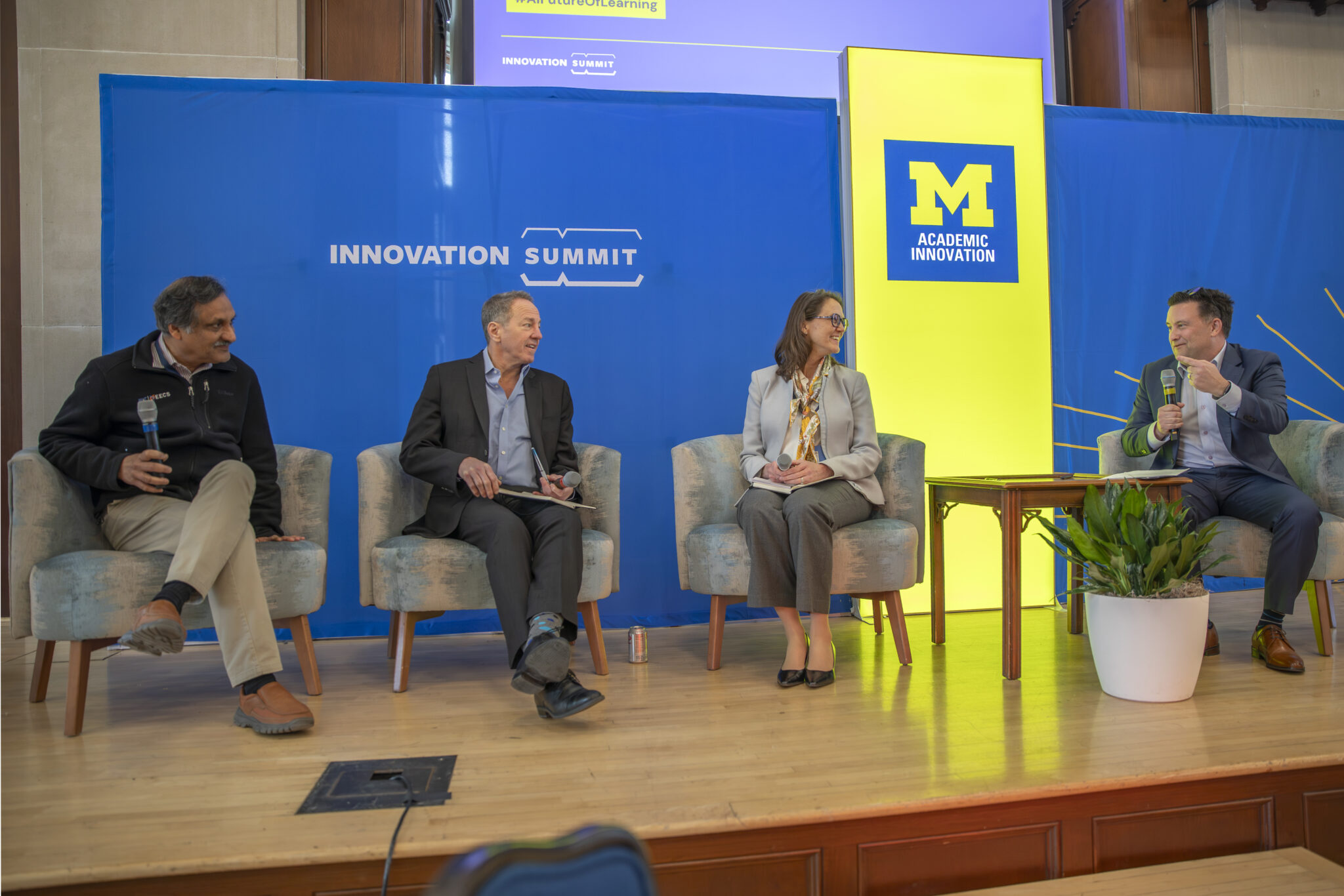
What the Future of Learning Looks Like in the Era of AI — from the Center for Academic Innovation at the University of Michigan, by Sean Corp

AI & the Future of Learning Summit brings industry, education leaders together to discuss higher education’s opportunity to lead, what students need, and what partnerships are possible

As artificial intelligence rapidly reshapes the nature of work and learning, speakers at the University of Michigan’s AI & the Future of Learning Summit delivered a clear message: higher education must take a leading role in defining what comes next.

One CEO of a leading educational technology company put it like this: “The only bad thing would be universities standing still.”

Universities must embrace their roles as providers of continuous, lifelong learning that evolves alongside technological change. 


This shift is already affecting early-career pathways. Employers are placing greater emphasis on experience, while traditional entry-level roles are becoming less accessible. There is often a gap between what a credential represents and the expectations of employers.

That gap is particularly evident in access to internships. Chris Parrish, co-founder and president of Podium, noted that millions of students compete for a limited number of internships each year, making it increasingly difficult to gain the experience employers demand.

“If you miss out on an internship, you’re twice as likely to be unemployed,” Parrish said. 


Summary: Accessible AI has killed traditional signals of legitimacy.

Experiments show $20 consumer tools can easily bypass verification. The solution is shifting toward contextual proof that verifies human uniqueness without exposing identity.


After Hours 1: The legal profession’s new value proposition — from jordanfurlong.substack.com by Jordan Furlong
The days of selling legal tasks by the hour are ending. Lawyers’ future value lies in safeguarding clients’ legal journeys by overcoming the most challenging obstacles on the way. Part 1 of 2.

As a result, legal work is dividing into two spheres, the first larger than the second: what Gen AI can satisfactorily address, and what it can’t.

  • Sphere 1: Legal Production. This is all the specialized intellectual work involved in generating legal solutions: researching, issue-spotting, summarizing, synthesizing, drafting, revising, reasoning, and analyzing. This is the bulk of lawyers’ traditional activity and billed hours. In future, it will be done faster, cheaper, and increasingly better with machines — either by clients themselves, or embedded in systems and platforms that reduce the need for lawyer involvement.
  • Sphere 2: Legal Judgment. This is higher-value work defined by the unpredictability, complexity, and impact of its challenges. In this sphere, you’ll find hard-decision advice, guidance under uncertainty, systematic dispute avoidance, strategic counsel, critical advocacy, risk prioritization, and high-stakes accountability. It’s likely (but far from certain) that this work will remain outside the reach of Gen AI. This is the sphere that holds the potential to support a future legal profession.

But not every legal journey is so simple or safe that the client can go it alone. Many times, Point B is more like Point F or Point R: a long and tortuous distance away. Many AI-generated maps will suggest a clear and direct route that bears little resemblance to the messy tangles of reality. On even moderately complex legal journeys, the unwelcome and the unexpected are always lurking. Something arises that was nowhere on the map, and until it gets resolved, the client can’t move any further towards their destination.


Below are some items from Jordan’s article — or by following a rabbit trail from his posting:


AI-Native Firms, Built by Private Equity, Will Strain Legacy Model — from news.bloomberglaw.com by Eric Dodson Greenberg

The emergence of AI-native law firms reveals the limits of a fixed binary that has characterized the legal market over the last year.

The straightest path to AI law firms isn’t innovation within the legacy model, or capital investing around it, but external capital being deployed to build competitors to legacy firms. These firms use AI and narrow regulatory openings to create from scratch tech-enabled law firms.

Not acquire them. Not invest around them.

Build them.

This third path is no longer theoretical.

The $3,500 Hour vs. The $500 Contract — from legaltechnologyhub.com by Brandi Pack

While rates at the top continue climbing, the operational foundation of legal work is being rebuilt.

Its pricing reflects that structure. Contract review between three and 50 pages costs $500. Short agreements are $250. Longer contracts are billed per page. Drafting from scratch is offered at a fixed fee. 

There is no running clock.

The premise is straightforward. If generative AI materially reduces the time required for standardized work, the cost base changes. And when the cost base changes, pricing models eventually follow.

.


From DSC:
This next item is not from Jordan, but may also be useful to some of you out there:

Want to Work at Legora, Harvey or Another Legal AI Startup? — from legallydisrupted.com by Zach Abramowitz
Podcast with a Biglaw Partner Who Now Occupies a Senior Role at Legora

In Episode 45 of Zach Abramowitz is Legally Disrupted, Kyle and dive into why building tech workflows and writing AI prompts should absolutely be considered billable work. We also explore why AI commoditizing the legal “grinders” and “minders” means old-school social skills are about to become your single biggest competitive advantage. Finally, Kyle goes into great detail about how exactly how he landed a top role at Legora and how others can do the same (hint: merely dropping your resume into a web portal is not enough).


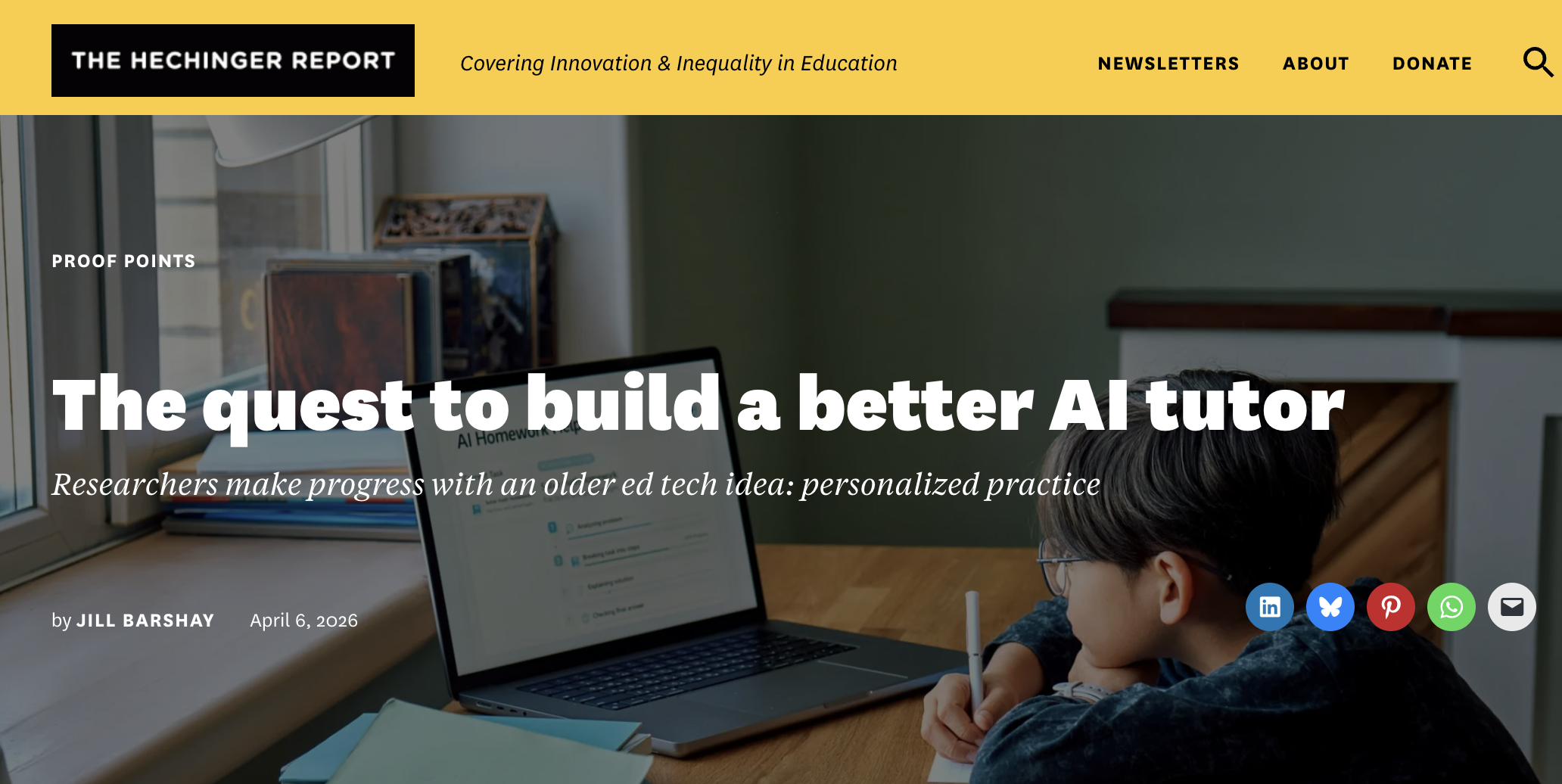
The quest to build a better AI tutor — from hechingerreport.org by Jill Barshay
Researchers make progress with an older ed tech idea: personalized practice

One promising idea has less to do with how an AI tutor explains concepts and more with what it asks students to practice next.

A team at the University of Pennsylvania, which included some AI skeptics, recently tested this approach in a study of close to 800 Taiwanese high school students learning Python programming. All the students used the same AI tutor, which was designed not to give away answers.

But there was one key difference. Half the students were randomly assigned to a fixed sequence of practice problems, progressing from easy to hard. The other half received a personalized sequence with the AI tutor continuously adjusting the difficulty of each problem based on how the student was performing and interacting with the chatbot.

The idea is based on what educators call the “zone of proximal development.” When problems are too easy, students get bored. When they’re too hard, students get frustrated. The goal is to keep students in a sweet spot: challenged, but not overwhelmed.

The researchers found that students in the personalized group did better on a final exam than students in the fixed problem group. The difference was characterized as the equivalent of 6 to 9 months of additional schooling, an eye-catching claim for an after-school online course that lasted only five months.

To address this, Chung’s team combined a large language model with a separate machine-learning algorithm that analyzes how students interact with the online course platform — how they answer the practice questions, how many times they revise or edit their coding, and the quality of their conversations with the chatbot — and uses that information to decide which problem to serve up next.


AI and the Law: What Educators Need to Know About Responsible Use in a Rapidly Changing Landscape — from rdene915.com by Dr. Rachelle Dené Poth, JD

As both an attorney and educator who has spent more than eight years researching, teaching, presenting, and writing about AI, I have worked with schools across K–12 and higher education that are navigating these exact questions. The legal implications of AI are not barriers to innovation, but I consider them to serve as guardrails that assist schools with adopting technology responsibly. The key is protecting students, educators, and institutions and staying informed. Understanding the legal landscape and any potential legal implications as a result of the use of AI in classrooms helps schools move forward with confidence rather than hesitation.

Sections of Rachelle’s posting include:

  • Why AI and the Law Matter in Education
  • Key Laws That Shape AI Use in Schools
  • Data Privacy and Vendor Responsibility
  • Transparency Builds Trust With Students and Families
  • Accessibility, Equity, and Emerging Legal Considerations
  • Teaching Digital Citizenship With AI Literacy
  • Supporting Schools and Organizations Through AI and Legal Guidance
  • Moving Forward With Confidence
 

Meta, YouTube found negligent in landmark social media addiction trial — from by Ian Duncan
A Los Angeles jury awarded $3 million in compensation to a young woman who alleged she had become addicted to the platforms as a child.

A Los Angeles jury found social media giant Meta and video platform YouTube negligent in a landmark trial, awarding $3 million in compensation to a young woman who alleged she had become addicted to the companies’ platforms as a child.

The verdict came at the end of a month-long trial that featured testimony by Facebook founder Mark Zuckerberg and a day after a jury in New Mexico ordered Meta to pay $375 million in penalties for endangering children. The twin verdicts are signs that legal protections which for decades made tech companies seem almost impervious are beginning to crack, as lawyers accuse the platforms of putting addictive or otherwise harmful features into their platforms.

With the armor of Silicon Valley companies fractured, they will now have to size up their appetite for future courtroom battles. There are thousands more lawsuits waiting to be heard, with young internet users, parents, school districts and state attorneys general all seeking to hold the industry accountable.


From DSC:
I have been proposing that the AI-based learning platform of the future will be constantly doing this — every single day. It will know what the in-demand skills are — at any given moment in time. It will then be able to direct you to resources that will help you gain those skills. Though in my vision, the system is querying actual/open job descriptions, not analyzing learning data from enterprise learners. Perhaps I should add that to the vision.


Coursera’s Job Skills Report 2026: Top skills for your students — from coursera.org

The Job Skills Report 2026 analyzes learning data from more than 6 million enterprise learners to identify the future job skills organizations need most. It’s designed for HR and L&D leaders; data, IT, and software & product development leaders; higher education administrators; and government agencies seeking actionable insights on workforce skills trends and AI-driven transformation.

Drawing on data from 6 million enterprise learners across nearly 7,000 organizations, the Job Skills Report 2026 guides you through the skills reshaping the global economy. This year’s analysis spans Data, IT, and Software & Product Development—and the Generative AI skills becoming essential for every role.


Law Firm AI Adoption: So Many Choices — from abovethelaw.com by Stephen Embry
Firms need to recognize reality, define what their legal professionals need, and then determine how to adopt and govern the use of AI tools.

It’s tough to be a law firm managing partner in the age of AI. So many choices, so little time. It’s like the proverbial kid in the candy store who has so many choices that they either can’t pick out anything or reach for too much. We see evidence of the first option in 8am’s recent outstanding Legal Industry Report, authored by Niki Black.

8am’s Legal Industry Report
One thing that stood out in the report was the discrepancy between use of AI by individual legal professionals and what firms are doing when it comes to AI adoption and guidance.  Almost 75% of those who responded said they were using general purpose AI tools like ChatGPT and Claude for work purposes. That’s pretty significant.


Legalweek: It’s time to re-engineer how legal work is delivered — from legaltechnology.com by Caroline Hill

AI for good
While focusing on the risks of AI going wrong, it is only fair to mention the conversations I had around using AI for good.  Two in particular stand out.

The first is the news from Everlaw that its Everlaw for Good Program has, over the past year, supported more than 675 active cases across 235 organisations, and expanded its support to a growing network of non-profit organisations.

The program extends Everlaw’s technology to organisations working to advance access to justice. In a recent survey by Everlaw, 88% of legal aid professionals said they are optimistic about AI’s potential to help narrow the justice gap.

“Mission-driven organizations are increasingly handling complex investigations and litigation with limited resources,” said Joanne Sprague, head of Everlaw for Good. “Expanding access to powerful, easy-to-use technology helps level the playing field so these teams can uncover critical evidence, take on more complex matters, and yield stronger results for the communities they serve.”


LawNext on Location: Visiting Everlaw’s Headquarters For A Conversation with AJ Shankar, Founder and CEO — from lawnext.com by Bob Ambrogi

The bulk of our conversation focuses on generative AI, and how Everlaw has approached it differently than much of the market. Rather than bolting on a chatbot, AJ says, Everlaw embedded AI deliberately throughout the platform — document summarization, coding suggestions, deposition analysis, fact extraction — always grounding responses in the actual documents at hand and citing sources so users can verify the work. The December launch of Deep Dive, which lets litigators pose a question and get a synthesized, cited answer drawn from an entire document corpus in about a minute, is the feature AJ calls a “new era” for discovery — one he genuinely believes represents a categorical shift.

 
© 2025 | Daniel Christian