Top Content Providers For Immersive Learning (2022) — from elearningindustry.com by Christopher Pappas

Summary: 

Immersive learning experiences allow learners to interact by simulating real-life scenarios. Are you ready to offer engaging virtual environments and experiences to your workforce? Dive right into this thoroughly curated top list featuring the best content providers for VR training and bring your teams one step closer to the Metaverse.


After an AI bot wrote a scientific paper on itself, the researcher behind the experiment says she hopes she didn’t open a ‘Pandora’s box’ — from insider.com by Hannah Getahun

Excerpt:

  • An artificial-intelligence algorithm called GPT-3 wrote an academic thesis on itself in two hours.
  • The researcher who directed the AI to write the paper submitted it to a journal with the bot’s consent.
  • “We just hope we didn’t open a Pandora’s box,” the researcher wrote in Scientific American.

AI Empowers Scalable Personalized Learning and Knowledge Sharing — from learningsolutionsmag.com by Markus Bernhardt

Excerpt:

AI aids in providing true personalization
Automation through AI is providing us with the tools necessary to deploy fully personalized digital learning, extremely fast and at scale. With the advent of this technology, we will see a revolution in digital training; in addition, I predict that the impact the digital piece will have on human-led efforts will lead to a further revolution of education, training, workshops, mentoring, and coaching.

How A.I. Could Help You Design Your Perfect Office (or Store) — from inc.com by Ben Sherry
Artificial intelligence may soon help fill the gap between your interior design skills and your imagination.

Excerpt:

Boom Interactive is one of several companies attempting to streamline the interior design process using automation. The Salt Lake City-based startup’s free app, Bubbles, which is scheduled to soft launch in the third quarter of 2022, uses artificial intelligence to read floor plans and create a “digital twin” of your real-life space, according to CEO and founder Timber Barker. Once a “twin” has been created, users have full freedom to customize the space by adding doors, erasing walls, and placing furniture.

The Increasing Role of Artificial Intelligence in Our Lives — from rdene915.com by Rachelle Dene Poth

Excerpt:

All of this recent information has made me even more curious about the role artificial intelligence will play over the next few months as we hopefully get back to more of a normal life experience and can engage in work and learning but also in leisure activities. What can we learn from the recent uptick in AI information and how can it help us in the future?

Optical illusions could help us build the next generation of AI — from digitaltrends.com by Luke Dormehl


How Alternative Credentials Can Help You Find Employees — from shrm.org by Kathryn Tyler
Focus on skills, not degrees, to increase your talent pool.

Excerpts:

“Alternative credentials,” such as the ones Brown attained, are increasingly available in the form of micro-credentials, digital badges and industry-recognized certificates. They’re less expensive than a college degree and designed to help prepare workers for better jobs.

IBM is ahead of the game in many respects. Six years ago, the tech giant began revising its job descriptions to focus on skills and not just educational attainment. On average, 50 percent of the company’s posted positions in the U.S. don’t require a bachelor’s degree.

“We call these ‘new-collar jobs,’ and they’re aligned to careers that require the right set of skills and a commitment to lifelong learning,” says Tommy Wenzlau, talent leader for new-collar initiatives at IBM, which employs more than 250,000 workers globally. “New-collar roles are in some of technology’s fastest-growing fields, including data science, cloud computing, application development, cybersecurity and digital design.”


Inside a radical new project to democratize AI — from technologyreview.com by Melissa Heikkilä
A group of over 1,000 AI researchers has created a multilingual large language model bigger than GPT-3—and they’re giving it out for free.

Excerpt:

PARIS — This is as close as you can get to a rock concert in AI research. Inside the supercomputing center of the French National Center for Scientific Research, on the outskirts of Paris, rows and rows of what look like black fridges hum at a deafening 100 decibels.

They form part of a supercomputer that has spent 117 days gestating a new large language model (LLM) called BLOOM that its creators hope represents a radical departure from the way AI is usually developed.

Unlike other, more famous large language models such as OpenAI’s GPT-3 and Google’s LaMDA, BLOOM (which stands for BigScience Large Open-science Open-access Multilingual Language Model) is designed to be as transparent as possible, with researchers sharing details about the data it was trained on, the challenges in its development, and the way they evaluated its performance. OpenAI and Google have not shared their code or made their models available to the public, and external researchers have very little understanding of how these models are trained.

Another item re: AI:

Not my job: AI researchers building surveillance tech and deepfakes resist ethical concerns — from protocol.com by Kate Kaye
The computer vision research community is behind on AI ethics, but it’s not just a research problem. Practitioners say the ethics disconnect persists as young computer vision scientists make their way into the ranks of corporate AI.

For the first time, the Computer Vision and Pattern Recognition Conference — a global event that attracted companies including Amazon, Google, Microsoft and Tesla to recruit new AI talent this year — “strongly encouraged”researchers whose papers were accepted to the conference to include a discussion about potential negative societal impacts of their research in their submission forms.


The new labor market: No bachelor’s required? — from hechingerreport.org by Lawrence Lanahan
More workers without degrees are landing jobs they’d have been shut out of before. Will it last?

Excerpt:

Thanks to a tight labor market, more good jobs are opening up to workers who lack a bachelor’s degree. A month after Maryland’s announcement, Colorado Gov. Jared Polis directed government agencies in his state to embrace hiring workers for skills, not degrees. Private sector employers have been rolling back B.A. requirements too.


Radar Trends to Watch: July 2022 — from oreilly.com
Developments in AI, Metaverse, Programming, and More

Excerpt (emphasis DSC):

The most important issue facing technology might now be the protection of privacy. While that’s not a new concern, it’s a concern that most computer users have been willing to ignore, and that most technology companies have been willing to let them ignore. New state laws that criminalize having abortions out of state and the stockpiling of location information by antiabortion groups have made privacy an issue that can’t be ignored.

Also relevant/see:


5 reasons why legal tech matters — from lawyer-monthly.com by Colin Bohanna

Excerpt:

5. Technology can improve access to justice
Using technology can help to increase access to justice in a number of ways. The increased adoption of videoconferencing technology seen during the pandemic has had a positive impact on those who have traditionally struggled to access legal services. That includes those living in rural areas, who may not live in proximity to a lawyer qualified to deal with their specific matter; those working in precarious situations that may not enable them to travel to meet a lawyer or who may have family- or elder-care responsibilities; and people with disabilities who may have mobility issues that make travel difficult.

Tech can also play an essential role in the support of legal aid. We know there’s a perception that the level of paperwork, admin, and invoicing requirements means the burden of conducting legal aid is high. As Clio is committed to transforming the legal industry, we offer a legal aid solution as part of our practice management software at no extra cost in order to increase access to justice, for all. It helps to cut legal aid processes drastically so that legal aid providers can focus on their client work and make legal aid work more financially viable.

Also relevant/see:

Top 10 Legal Operations Trends in 2022. — from jdsupra.com

Key legal operations trends for 2022

1. Growing legal operations teams
2. Formalizing the legal operations function
3. Implementing a diversity, equity, and inclusion (DE&I) program
4. Finding new ways to improve processes
5. Insourcing more work
6. Strengthening vendor management
7. Expanding the use of data analytics tools
8. Increasing technology investments
9. Strengthening the law department’s technology acumen
10. Improving data security


Will a “Google PhD” become as good as a university-granted PhD? — from rossdawson.com by Ross Dawson

Excerpt:

A fundamental issue now is the degree to which employers care about the piece of paper as against the knowledge and capability. That is rapidly shifting as companies realize they will often miss out on exceptionally talented people if they insist on formal qualifications.

Entrepreneurs of course only care whether they have the knowledge to do what they’re undertaking.

It is a shifting landscape. Traditional advanced degrees have their place and will not disappear.

But “Google PhDs” will in some cases be as good, if they result in an equivalent level of expertise.


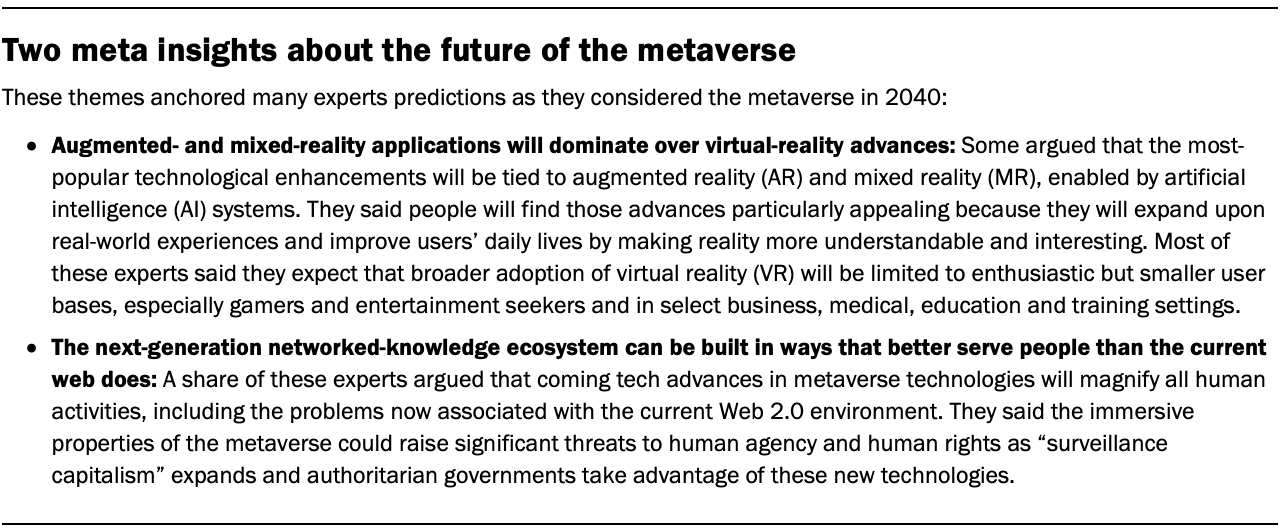
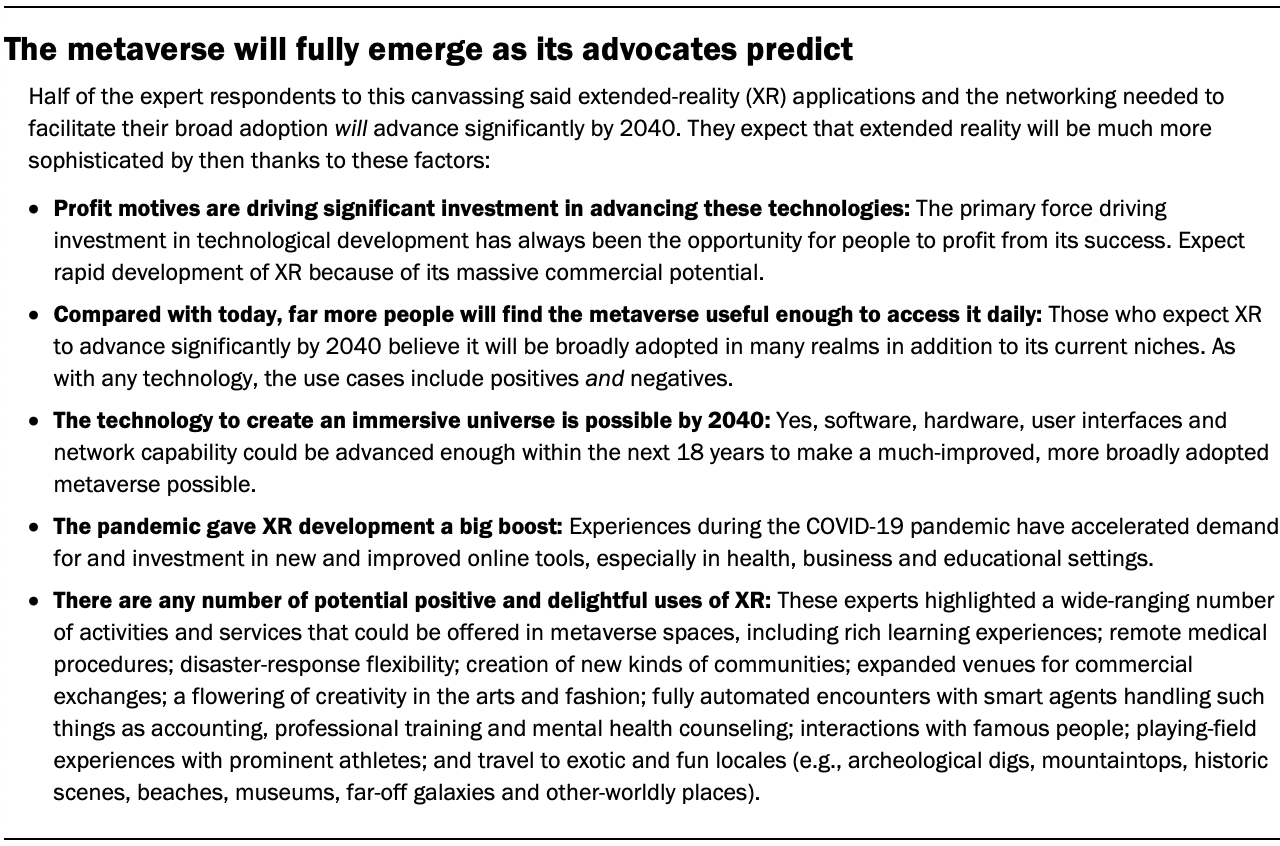
The Metaverse in 2040 — from pewresearch.org by Janna Anderson and Lee Rainie
Hype? Hope? Hell? Maybe all three. Experts are split about the likely evolution of a truly immersive ‘metaverse.’ They expect that augmented- and mixed-reality enhancements will become more useful in people’s daily lives. Many worry that current online problems may be magnified if Web3 development is led by those who built today’s dominant web platforms


The metaverse will, at its core, be a collection of new and extended technologies. It is easy to imagine that both the best and the worst aspects of our online lives will be extended by being able to tap into a more-complete immersive experience, by being inside a digital space instead of looking at one from the outside.

Laurence Lannom, vice president at the Corporation for National Research Initiatives

“Virtual, augmented and mixed reality are the gateway to phenomenal applications in medicine, education, manufacturing, retail, workforce training and more, and it is the gateway to deeply social and immersive interactions – the metaverse.

Elizabeth Hyman, CEO for the XR Association


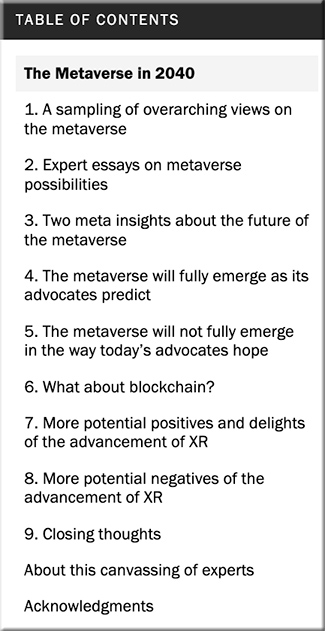
The table of contents for the Metaverse in 2040 set of articles out at Pew Research dot org -- June 30, 2022


Blurring the lines between education and workforce — from hechingerreport.org by Javeria Salman
A proposition to ‘blur’ the boundaries between K-12, higher ed, and the workforce industry

Excerpts:

One idea that’s been gaining steam since last year is to break down barriers between high school, college and career to create a system that bridges all three.

The concept is called the “Big Blur.”

“What would it look like to change the typical, or what we think of as the conventional high school experience and instead design something that was built for the modern economy?” said Vargas.

Vargas said that JFF is arguing for new programs or institutions that serve students in grades 11 through 14 (grades 13 and 14 being the first two years of college, under our current configuration). The institutions would be co-designed with regional employers so that all students get work-based learning experiences and graduate — without tuition costs — with a post-secondary credential that has labor market value.


Only 37% of Lawyers are Satisfied with their Firm’s Technology — from artificiallawyer.com

Excerpt:

A new survey has found that only 36.7% of lawyers are satisfied with the tech tools on offer at their firms, and with only 37.1% saying that they had used a new product at their law firm in the last six months. So, they’re not too happy with what they’ve got, while most firms are not bringing in anything much that is new either.


Mat Rotenberg, CEO of Dashboard Legal, the company that conducted the survey, told Artificial Lawyer that a key factor here is the retention of talent, i.e. that underinvesting in tech that removed drudgery would inevitably contribute to lawyer attrition.

‘This survey raises the question of whether firms are doing what they can to retain top talent. It appears that partners are not asking associates what they want to make their lives better.’

He noted that the survey data also showed that although lawyers were not that pleased with what was on offer, they did indeed value tech solutions and believed they could help.


Screenshot of Adobe Live -- is Adobe Live a type of component of our future learning ecosystems?

From DSC:
It seems to me that this is one of the types of learning experiences that we will have in the future — i.e., where you can tap into a variety of live/virtual streams of content whereby you can peer over the shoulder of experts using products and/or services.

streams of content are ever flowing by -- we need to tap into them and contribute to them

 
© 2025 | Daniel Christian