Unbundled: Reimagining Higher Education — from huffingtonpost.com by Anant Agarwal

Excerpt (emphasis DSC):

As a result, many educators are now asking probing questions about traditional degree pathways. Should we require university students to obtain a degree in a specialized field? Should we expect students to know at the age of 18 what they want to do for the rest of their lives? Should universities limit their degree programs to four-year spans? Should the concept of a degree as the defining credential itself be revisited? Shifting from this traditional approach may significantly affect the affordability, efficiency and quality of a college education. It might even change the very manner in which universities are structured, as Jeffrey Selingo describes in his book College UnBound. One key to this shift might be the concept of unbundling many of the components that make up the traditional approach to higher education: time, function and content.



DanielChristian-The-unbundling-of-higher-education


Amazon’s Push in Education [Schaffhauser]

Amazon’s Push in Education — from CampusTechnology.com by Dian Schaffhauser
In this interview with Campus Technology, Amazon Web Services General Manager Steve Halliwell reveals two new AWS services that will have an impact on the education market, explains why long-term data storage is becoming a challenge for researchers and shares his thoughts about the importance of “democratizing” infrastructure for students to transform education.

  1. Workspaces
  2. Kinesis
 

You’ll never guess who’s disrupting online learning — from forbes.com by Chris Proulx, President & CEO of eCornell

Excerpt:

The reality behind the hype is that online education has been disruptive for over a decade, well before MOOCs. Certainly since the economic downturn in 2009, we have seen an accelerated focus on agile work practices and more rapid adjustments in company strategy. This change has created opportunities for employees to drive their career growth by becoming masters at acquiring and applying new skills in short bursts. Much of this has come through on the job skill development, but individuals and organizations alike are also adapting their more formal training and education approaches so it aligns with the accelerating pace of business.

First, in the 21st economy, education needs to be as much about context as it needs to be about content. Second, it needs to put the learner in control of the pace, timing, and application of the learning. Third, it needs to blend concepts with practice by aligning expertise from traditional faculty with non-traditional expert-practitioners in order to drive relevance.

But just like with iTunes, the next step for the digitization of higher ed will need to come with new sustainable business models, not just technology, to drive widespread adoption and change.


Book Sculptures by Guy Laramee [designsoak.com]


— from Hari Gottipati

Excerpt:

What is iBeacon?

Using Bluetooth Low Energy(BLE), iBeacon opens up a new whole dimension by creating a beacon around regions so your app can be alerted when users enter them. Beacons are a small wireless sensors placed inside any physical space that transmit data to your iPhone using Bluetooth Low Energy (also known as Bluetooth 4.0 and Bluetooth Smart).

For example, imagine you walk into a mall with an iPhone 5s (comes with iOS 7 and iBeacon). You are approaching a Macy’s store, which means your iPhone is entering into Macy’s iBeacon region. Essentially iBeacon can transmit customized coupons or even walking directions to the aisle where a particular item is located. It can prompt a customer with special promotions or a personalized messages and recommendations based on their current location or past history with the company. Smartphones that are in an iBeacon zone will benefit from personalized microlocation-based notification and actions.

iBeacon demonstration example mobile shopping


Also see:


From DSC:
How can this sort of thing be used in blended/hybrid learning environments? Will this be a part of our next generation smart classrooms/teaching spaces? A new way to take attendance? Share/distribute personalized content?


Learning and Performance Support Systems — from Stephen Downes

Excerpt:

This post is to introduce you to our Learning and Performance Support Systems program, a new $19 million 5-year initiative at the National Research Council that I will be leading.

If I had to depict LPSS in a nutshell, I would describe it as a combination of the MOOC project we’ve been working on over the last few year, as well as our work in Personal Learning Environments (PLEs). The objective is to build a system where individuals can access, and get credit for, learning from any education provider at all, whether from home, the workplace, or at a school.

What follows is a version of the case we presented to NRC senior executive in order to have this program approved. They supported our proposal, and for the last few weeks I have been engaged in developing the program implementation with a large team of NRC colleagues.

Learning and Performance Support Systems
The LPSS program will deliver software algorithms and prototypes that enable Canada’s training and development sector to offer learning solutions to industry partners that will address their immediate and long term skills challenges.


I originally saw this via Tony Bates at:


From DSC:
Congratulations Stephen! May these efforts help many people reinvent themselves and stay marketable — while helping them pursue their gifts, passions, abilities.


Also see:


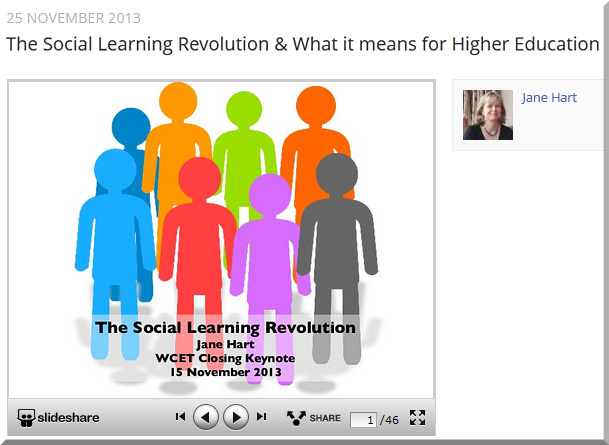
TheSocialLearningRevolution2-JaneHartNov2013


From DSC:
Thanks Jane for an excellent presentation here! For those of us working in higher education, please take some time to review this presentation.  The lines are continuing to blur between K-12, higher education, and the corporate training/L&D world. We are all into lifelong learning now. No more quick sprints. We are all running marathons now.


From DSC:
Is higher education on the same trajectory as Blockbuster, Kodak, & others who didn’t adapt?  Some items that prompted me to ask this question (again):


Private Distress — from insidehighered.com by Ry Rivard

Excerpt:

Some private colleges that managed to weather the recession are finding new troubles.

So they are announcing layoffs, cutting programs and more. Almost all of these small to mid-sized privates are tuition-dependent and lack large endowments. National declines in the number of traditional college-age population mean students just aren’t showing up to privates, which are facing competition from public colleges that are more stable now than a few years ago and the reality that privates cannot afford to indefinitely lure students by cutting prices with generous financial aid packages. And this could become a huge problem.


Higher education: On a crash course for reinvention — huffingtonpost.com by Bob Kerrey


Obama to Higher Ed: Find Ways to Lower Costs, Maintain Quality — from aspireblog.org by Sara Jacobi

Excerpt:

 “The Secretary is particularly interested in experiments that will improve student persistence and academic success, result in shorter time to degree, and reduce student loan indebtedness,” reads the notice issued by the Department of Education.


What’s the future of the CIO? — from cioofthefuture.com by Peter EvansGreenwood
CIOs have an opportunity to drive strategy and create business value, and not just reduce costs 

From DSC:
The sections entitled “The demise of the Chief Infrastructure Officer” and “Technology is now central to how our organizations engage their market” seem especially appropriate.

The CIO of 2020: The future of the Chief Information Officer — from innovationexcellence.com by Paul Muller

CDOs are reaching new heights — and quickly — from sloanreview.mit.edu by Michael Fitzgerald
Is the chief digital officer position the new path to the chief executive title?


A map of learning theory concepts, theorists, paradigms and disciplines — from by Jimmy Daly
Learning technologist Robert Millwood’s map makes learning theories more accessible than ever.


© 2025 | Daniel Christian